When Hormuz Stopped Being an Oil Story
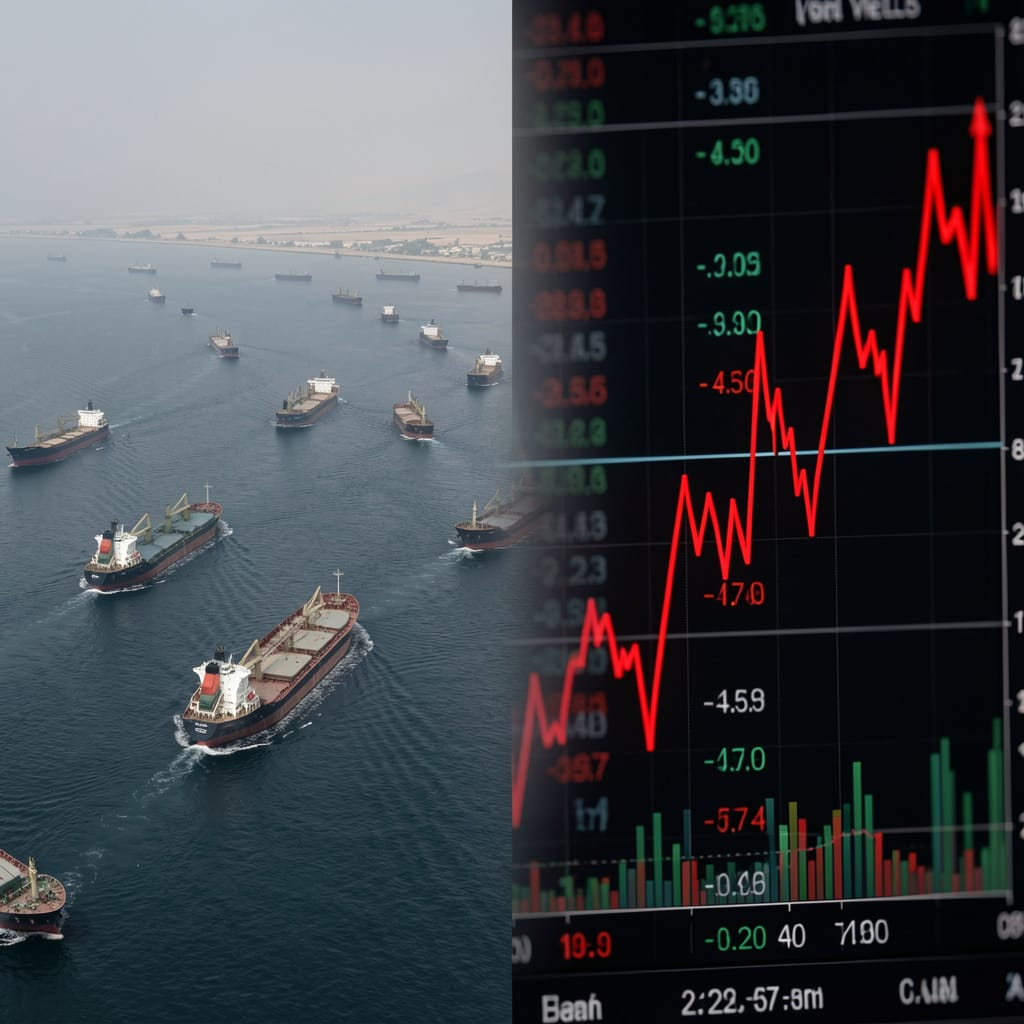
For eleven weeks, the Strait of Hormuz crisis has been framed as an energy story. Crude prices, tanker rates, stranded vessels, mine clearance timelines — the vocabulary of shipping and petroleum. That framing was always incomplete. Last Friday, the bond market made it impossible to sustain.
On May 15, as the Trump-Xi Beijing summit concluded without a Hormuz breakthrough, government bond markets fell across the world simultaneously. U.S. Treasury 10-year yields climbed above 4.5%. Japan's 30-year borrowing costs hit 4% for the first time in history. UK long-bond yields reached a 28-year high. The S&P 500 fell more than 1%, led by technology shares. Oil climbed back above $105 a barrel.
In a single trading session, the Hormuz crisis graduated from a commodity shock to a macro financial event — the kind that forces central banks to choose between fighting inflation and supporting growth, that reprices risk across every asset class, and that generates economic damage that outlasts the conflict that caused it by years.
This post explains what happened, why it matters, and what it means for the path out of the crisis.
From Oil Shock to Stagflation Fear
The transmission mechanism from a closed strait to a bond market selloff runs through inflation — and it is faster and more direct than most financial commentary has acknowledged.
The sequence works like this. The Strait of Hormuz closure removed roughly 13 million barrels per day of oil supply from global markets at its peak. That supply shock pushed Brent crude from around $75 a barrel before the war to above $120 at the March peak, before partially retreating as Cape of Good Hope rerouting and strategic reserve releases provided partial relief. Crude is now trading above $105 — still 40% above pre-war levels.
Higher energy prices feed into consumer prices with a lag of roughly six to eight weeks. That lag is now expiring. U.S. consumer price data released last week showed a sharp rise in both headline and wholesale inflation — the back-to-back reports that Bloomberg described as "fueling speculation that the Federal Reserve and other central banks will need to shift to tightening monetary policy." The European Central Bank had already postponed its planned rate reductions in March, raising its 2026 inflation forecast and cutting GDP growth projections.
This is the stagflation scenario that economists have been warning about since March — and the bond market is now pricing it in. Stagflation is the combination of rising inflation and slowing or negative growth. It is the hardest macroeconomic environment for central banks to navigate, because the tools for fighting inflation — higher interest rates — make the growth problem worse, and vice versa. As Columbia Threadneedle portfolio manager Ed Al-Hussainy put it last Friday: "Markets are starting to price the Fed having to work harder to tamp down inflation."
The Numbers Behind the Crisis
The scale of economic disruption the Hormuz closure has produced is extraordinary — and much of it has received far less attention than the diplomatic and military dimension.
The International Energy Agency has characterised the closure as "the largest supply disruption in the history of the global oil market" — larger than the 1973 OPEC embargo, larger than the 1979 Iranian revolution, larger than the 1991 Gulf War. Those previous shocks reshaped the global economy for years. This one is still ongoing.
The Gulf Cooperation Council states — Saudi Arabia, UAE, Kuwait, Qatar, Bahrain, Oman — collectively rely on the strait for the vast majority of their energy exports. Oil production across Kuwait, Iraq, Saudi Arabia, and the UAE dropped by a reported 6.7 million barrels per day by March 10, and by at least 10 million barrels per day by March 12. The GCC economic model — export hydrocarbons, import almost everything else — has been described as having undergone a systemic collapse.
The food dimension is less reported but potentially more consequential. Gulf states rely on the strait for over 80% of their caloric intake. By mid-March, 70% of the region's food imports were disrupted. Iran's strikes on desalination plants — which provide 99% of drinking water in Kuwait and Qatar — have shifted the crisis from fiscal contraction toward what some analysts are describing as a humanitarian emergency.
Beyond the Gulf, the disruption extends into supply chains that most consumers have never associated with the Middle East. The Gulf region accounts for roughly 45% of global sulfur supply — a feedstock for fertilisers, metal processing, and industrial chemicals. Urea prices have risen 50% since the war began. Helium, critical for semiconductor manufacturing and medical imaging, transits the strait in significant quantities. The UN World Food Programme has warned that disruptions to fertiliser supply are driving long-term increases in global food prices that could produce conditions similar to the 2022 food crisis.
Europe is facing the crisis through a particularly uncomfortable lens. The conflict coincided with historically low European gas storage levels — estimated at just 30% capacity following a harsh 2025-2026 winter. Dutch TTF gas benchmarks nearly doubled to over €60 per megawatt-hour by mid-March. UK inflation is expected to breach 5% in 2026. Chemical and steel manufacturers across the EU have imposed surcharges of up to 30% to offset surging energy costs.
The Bond Market's Message
What the bond market said on Friday is something that commodity markets and equity markets had been saying for weeks, but more quietly: this crisis does not have a near-term resolution, and the longer it continues, the more structurally damaging its economic effects become.
Bond markets are, in this sense, the most honest of financial markets. They price expectations about inflation and growth over years and decades, not days. When UK long-bond yields hit a 28-year high and Japan's 30-year borrowing costs reach an all-time record in the same trading session, the signal is not about last week's oil price. It is about what central banks will have to do over the next two to five years to manage the inflation that the Hormuz crisis is generating.
That signal has consequences beyond financial markets. Higher bond yields mean higher borrowing costs for governments, businesses, and households. In the United States, the 30-year mortgage rate climbed to 6.38% as early as March 26 — a level that effectively freezes large segments of the housing market. In Europe, governments already carrying significant debt loads from the post-COVID spending period face rising interest costs at precisely the moment their economies are being hit by an energy shock.
One energy geopolitics expert interviewed by CNBC last week put the oil market implications starkly: "I think we have a lingering risk premium on Brent oil, and it's going to be in the range of $80 to $100 a barrel for the foreseeable future" — meaning even a full resolution of the Hormuz crisis would not return energy prices to pre-war levels for an extended period.
The Stalemate That Nobody Can Afford — But Nobody Can End
The bond market selloff happened in the same week that the Beijing summit produced no Hormuz breakthrough. That juxtaposition is not coincidental. The market is pricing the growing probability that the diplomatic track remains blocked, that the strait stays effectively closed through the summer, and that the economic damage compounds from a supply shock into a structural inflation and growth problem.
The expert consensus on the diplomatic timeline is sobering. The CNBC interview with energy geopolitics veteran Raad Alkadiri is representative: "We're probably a month or two away from" a deal — with the caveat that a deal would have to be guaranteed by a trusted third party, and "there's no trust at all between the U.S. and Tehran right now, because the bombs have been dropping every time they've sat down to negotiate."
The structural barriers to a deal have not changed. Iran's IRGC hardliners retain control of the nuclear programme, the missile forces, and the maritime operations that keep the strait closed. Washington cannot accept Iran's demand for sovereignty over the waterway without surrendering its primary leverage for nuclear concessions. Neither side has yet reached the breaking point that forces genuine compromise.
And yet the pressure is accumulating. Trump's Truth Social posts have become progressively more threatening — "the Clock is Ticking, TIME IS OF THE ESSENCE" — suggesting that domestic political pressure, driven partly by gas prices at $4.52 a gallon and now by bond market turbulence, is reducing his tolerance for a prolonged stalemate. Iran's own economy, meanwhile, is not immune to the bond market's message: higher global borrowing costs and slower growth reduce demand for oil, which is the primary revenue source for any future Iranian economic recovery.
What to Watch
Three indicators will tell you whether the bond market's Friday signal is the beginning of a sustained financial deterioration or a one-week shock that stabilises.
Central bank communications. The Federal Reserve's next scheduled meeting is in June. If Fed officials begin signalling that the Hormuz-driven inflation is forcing a reassessment of rate policy, that will validate the bond market's pricing and extend the selloff. Watch for any deviation from the Fed's current "wait and see" language.
The 10-year Treasury yield. Above 4.5% is where the bond market is flashing genuine concern. If it moves toward 4.75% or above in the coming days, the financial dimension of this crisis will dominate headlines in a way that creates new political urgency for a deal — in both Washington and Tehran.
European gas storage. The summer refill season begins now. If Europe cannot restore gas storage to adequate levels by September — a target that requires LNG flows through the strait or significant rerouting — the continent faces an acute energy crisis heading into winter. That scenario would dramatically increase European diplomatic pressure on both the U.S. and Iran.
The Bottom Line
The Hormuz crisis has always been more than an oil story. It has been a food story, a fertiliser story, a shipping story, a geopolitical story. Last Friday it became, unmistakably, a financial story — one that is now moving bond yields in Tokyo, London, and New York simultaneously.
That transition matters because financial market pressure operates on a different timeline than diplomatic pressure. A bond market selloff does not wait for the next round of Pakistani mediation or the next Trump Truth Social post. It prices expectations, adjusts borrowing costs, and generates economic damage in real time — regardless of what is happening at the negotiating table.
The Strait of Hormuz is 33 kilometres wide at its narrowest point. Last Friday, its closure was visible in bond markets on the other side of the planet. That is the measure of how consequential this crisis has become — and how urgent its resolution is.
Track energy prices, shipping data, and market developments in real time at the Hormuz Strait Monitor dashboard.
See the numbers in real time
Track oil prices, ship transits, insurance premiums, and strait status — updated every hour.