The Walls Closing In: How Gulf Allies and Congress Are Constraining Trump's War Options
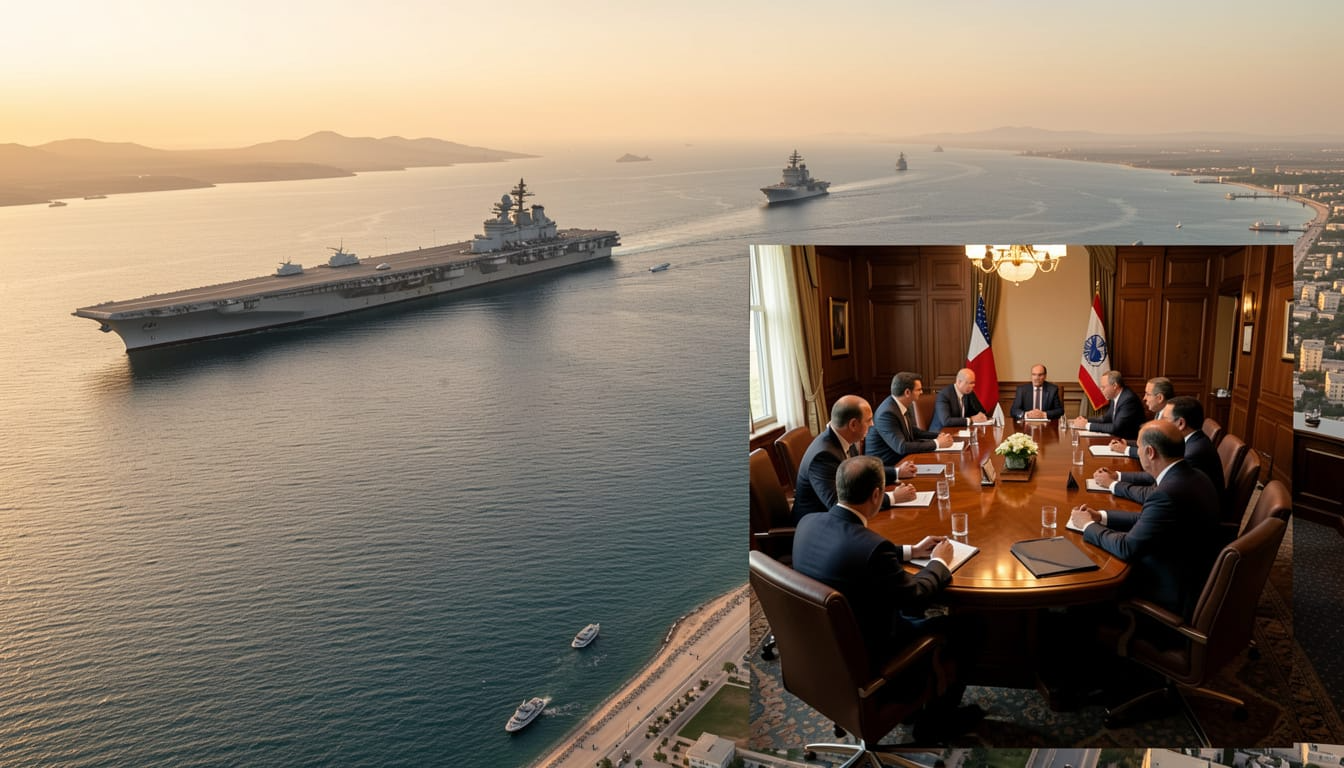
On Monday evening, Donald Trump stood at the White House and made a remarkable admission. He had been an hour away from ordering "a very major attack" on Iran. He had called it off — not because of a diplomatic breakthrough, not because of military advice, but because Gulf allies asked him to wait two to three days. "There seems to be a very good chance that they can work something out," he said. "If we can do that without bombing the hell out of them, I'd be very happy."
The sentence that received less attention was the one that followed: he was putting the strike off "for a little while, hopefully, maybe forever."
That "maybe forever" is the most significant phrase Trump has uttered about this war in weeks. It signals something important about where the conflict now stands: the military option that defined the first three months of the crisis is being squeezed from two directions simultaneously — Gulf allies from the outside, Congress from the inside. The walls are closing in.
The Gulf Allies' Veto
To understand why Gulf allies intervening to stop a U.S. strike is so significant, it helps to recall where these same governments were three months ago.
In March, the UAE's ambassador to Washington published an op-ed in the Wall Street Journal describing Iran as "a threat to global security and economic stability" and calling for a "conclusive solution" to the crisis. UAE Foreign Ministry officials repeatedly described Iranian attacks as a "flagrant violation of national sovereignty and international law" and affirmed the nation's "right to respond." Saudi Arabia, for its part, publicly called for the strait to be restored to its pre-war state.
These are not countries that were urging restraint. They were, in the early weeks of the conflict, among the most hawkish voices in Washington's coalition — welcoming American military pressure on a neighbour they have viewed as an existential threat for decades.
That has changed. On Sunday, a drone struck the edge of the UAE's sole nuclear power plant — an "unprovoked terrorist attack," in Abu Dhabi's words. Iran has launched repeated drone and missile barrages at Gulf infrastructure throughout the conflict. Kuwait and Qatar have faced disruptions to their desalination plants. The Gulf states have been targets, not bystanders.
And yet it was these same governments — now victims of Iranian attacks — who called Trump on Monday and asked him not to escalate. "Gulf allies asked him to wait two to three days because they feel they are close to a deal," Trump said. The calculation is straightforward: whatever damage Iran has inflicted on Gulf infrastructure, the damage from a resumed full-scale U.S. bombing campaign would be worse. Higher oil prices. More missiles. More drones. More instability on their doorstep. Better to absorb the current pain and push for a negotiated end.
That calculation also reflects something Gulf leaders understand that Washington sometimes does not: proximity matters. The U.S. can launch strikes from carriers in the Arabian Sea. It cannot escape the consequences that follow. Gulf states cannot.
The UAE's internal tensions illustrate how complicated this picture has become. Senior adviser Anwar Gargash issued a pointed criticism of some Gulf neighbours this week, lamenting a "confusion of roles" among states in the region. "The role of the victim has become mixed with the role of the mediator," he said — a barely veiled rebuke of Oman, which has maintained its traditional back-channel role with Tehran throughout the conflict. The Gulf is not monolithic. But on the specific question of stopping Tuesday's strike, it spoke with one voice.
Congress Enters the Room
The second constraint on Trump's military options is domestic — and it is moving faster than the White House appears to have anticipated.
On Tuesday, the Senate voted to advance a war powers resolution that would block Trump from ordering further strikes on Iran. Four Republicans broke with their party: Rand Paul of Kentucky, Susan Collins of Maine, Lisa Murkowski of Alaska, and Bill Cassidy of Louisiana — the last of whom had just lost his Republican primary, removing the electoral constraint on his vote. The resolution cleared the procedural hurdle to force a full Senate debate — the first successful step of its kind since the war began.
The resolution advanced in the Senate but was blocked in the House, where Republicans narrowly defeated it — the seventh time a war powers measure has been killed. But the trajectory is clear. Each successive vote has picked up additional Republican support. Democrats, led by Senator Tim Kaine, are pursuing a deliberate strategy of forcing repeated votes: put Republicans on the record defending an unpopular war, week after week, until enough of them break.
The war powers question is constitutionally significant. Congress never authorised this war. Trump launched Operation Epic Fury under presidential war powers — the same authority that every post-9/11 president has used to conduct military operations without a formal declaration of war. The Senate's procedural advances do not, by themselves, stop the strikes. But they signal that the political consensus sustaining the war is eroding — and that the administration cannot assume indefinite congressional acquiescence.
Trump's response to the Senate vote was characteristic: dismissive. He said the war is "very popular" and that he doesn't have "enough time to keep explaining the rationale for it." The polling tells a different story. Public support for the Iran campaign has fallen steadily since March, driven by gas prices above $4.50, rising mortgage rates, and bond market turbulence that is now visible in household budgets and business financing costs. The seven war powers votes that have been blocked represent seven moments when the White House had to spend political capital it could have deployed elsewhere.
Iran's Reading of the Room
Tehran is watching both constraints closely — and drawing conclusions.
Iran's revised terms, submitted to Pakistani mediators this week, continue to insist on sovereignty over the Strait of Hormuz and war reparations. The nuclear programme remains conspicuously absent from Iran's counter-proposals. These are not the terms of a side that believes it is losing.
IRGC General Rezaei put it bluntly on Tuesday: "The Americans must either submit to diplomacy and our conditions or submit to the power of our missiles. The history of the Strait of Hormuz will never return to its previous state, and no power can reopen it without our consent."
That statement is maximalist — designed for domestic consumption as much as international signalling. But the underlying logic is coherent. Iran has observed that Gulf allies stopped a U.S. strike. It has observed that four Republican senators broke with the White House on war powers. It has observed that Trump himself said "maybe forever" about ending the military campaign. From Tehran's perspective, time is working in its favour.
Whether that reading is correct depends on what happens in the next two to three days — the window Gulf allies requested before Trump reconsiders his military options. Iran said it has submitted a new revised proposal. The U.S. has not yet formally responded. Pakistani mediators are cautiously optimistic. A South Korean tanker crossed the strait on Wednesday — a small but notable sign that Iran is managing selective access rather than total closure.
The Rift That Could Determine Everything
The most consequential dynamic in the current phase of the crisis may not be between the U.S. and Iran at all. It may be within the Gulf itself.
The UAE and Saudi Arabia are increasingly pulling in different directions. Riyadh, which controls the world's largest oil reserves and has the most to lose from prolonged instability, has been quietly pushing for diplomatic resolution. Abu Dhabi, which has absorbed the most direct Iranian attacks — including Sunday's nuclear plant drone strike — is more hawkish, even as it joined the request to pause Tuesday's strikes.
Oman sits in a category of its own: it owns coastline on the strait, maintains relations with Tehran, and has served as a back-channel between Washington and Iran for decades. Oman's role in whatever deal eventually emerges is likely to be significant.
The UAE's Gargash explicitly criticised "grey stances" that confuse victimhood and mediation. That language is a pressure campaign on Oman and Qatar — pushing Gulf states to choose a side rather than hedge. If it works, it could narrow the diplomatic space for a deal. If it fails, it could deepen the Gulf's internal divisions at precisely the moment when a unified regional position might be the most effective lever available.
The Narrowing Options
Trump's military options are not gone. He retains the ability to order strikes, and the Senate's war powers resolution, even if it eventually passes, faces a certain presidential veto. But the political cost of escalation has risen sharply in the past week.
Gulf allies — the countries whose territory and infrastructure host the U.S. military presence that makes strikes possible — have publicly asked for restraint. The Senate has advanced a resolution challenging the war's legal basis. Domestic polling has turned. Bond markets are pricing in a prolonged stalemate. Gas prices are not falling.
The two-to-three day window Gulf allies requested has now passed without a formal U.S. response to Iran's revised terms being announced publicly. That silence is itself a signal — of a White House still weighing options, still hoping diplomacy produces what military pressure has not.
"For a little while, hopefully, maybe forever." That is not the language of a commander in chief with unlimited options. It is the language of a president feeling the walls close in.
Track diplomatic developments, vessel movements, and energy market data in real time at the Hormuz Strait Monitor dashboard.
See the numbers in real time
Track oil prices, ship transits, insurance premiums, and strait status — updated every hour.