Open, Closed, or Contested? The Strange New Reality of the Strait of Hormuz
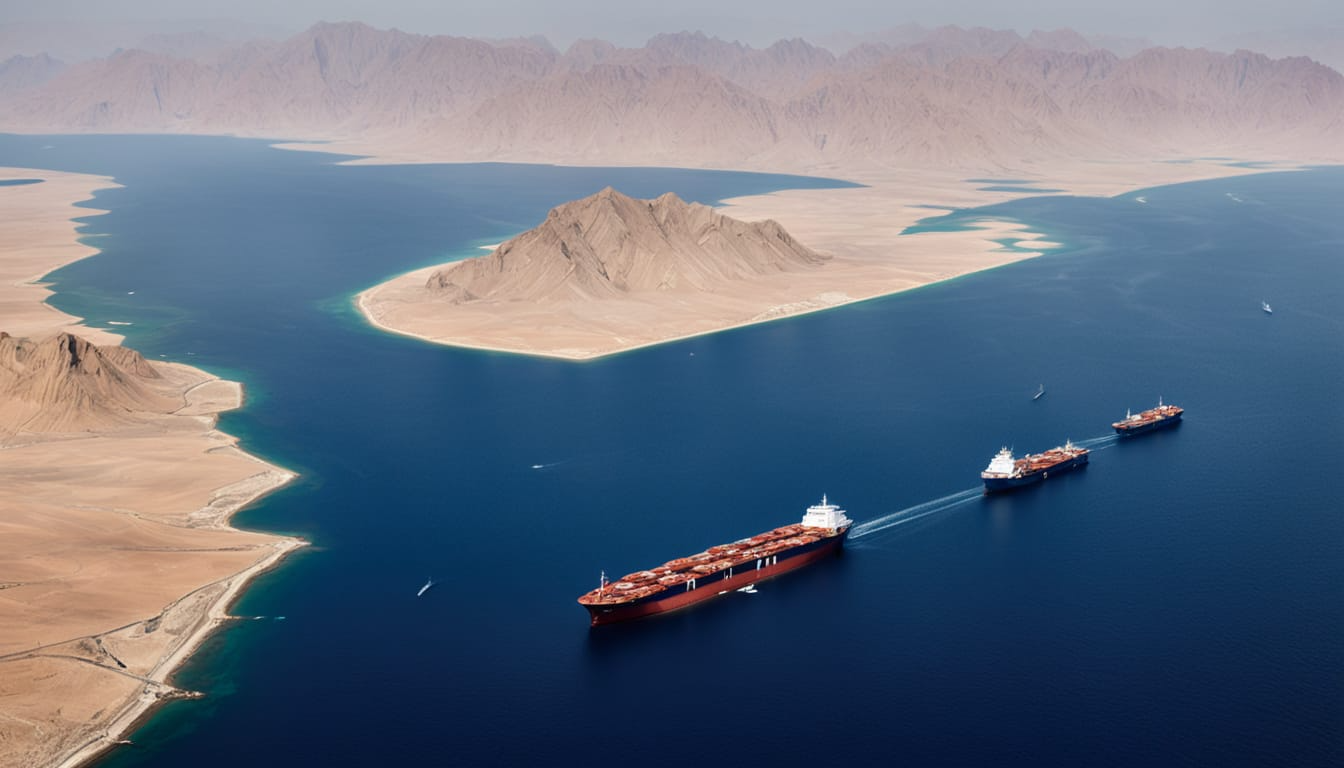
On Saturday morning, Iran's IRGC military command broadcast a message across maritime communication channels: the Strait of Hormuz was closed to all vessel traffic. Ships should not approach. Their security could not be guaranteed.
Within hours, Iran's own foreign ministry told Tasnim news agency that shipping through the strait was "operating normally" and denied any closure.
US CENTCOM posted on X that commercial ship traffic had increased on June 20. Fifty-five ships transited on Saturday. Vessels are turning over day to day.
All three statements are, in their own way, accurate. And that tells you almost everything you need to know about where the Hormuz crisis stands right now, five days after the MOU was signed at Versailles.
Two Routes, Two Sets of Rules
The key to understanding the current situation is geography. The Strait of Hormuz has two navigable routes — and they are operating under completely different conditions.
The northern route runs through Iranian territorial waters, close to Larak Island. This is the internationally recognised Traffic Separation Scheme — the route that ships used before the war began. It remains closed. The central channel is still mined. Iran's Persian Gulf Strait Authority has published a permitting system for vessels wishing to use the northern route, but the combination of mines, IRGC control, and prohibitive insurance costs makes it effectively unusable for most commercial operators.
The southern route runs through Omani territorial waters and is coordinated by the US Navy's Naval Cooperation and Guidance for Shipping (NCAGS). Iran does not recognise this route as legitimate — it explicitly falls outside the permitting system Iran has created. But ships are using it. Fifty-five did on Saturday. CENTCOM reports traffic is flowing.
The result is a waterway that is simultaneously closed and open, depending on which route you take, which government body in Tehran you ask, and whether your flag state has a relationship with the IRGC that allows northern route passage.
Why Iran's Government Is Contradicting Itself
The contradiction between the IRGC military command and Iran's foreign ministry is not an accident or a miscommunication. It is a structural feature of how Iran's system works — and it is the same dynamic that has defined this entire crisis.
The IRGC answers to the Supreme Leader. The foreign ministry answers to the elected government. These are not the same chain of command, and they do not always want the same things.
The IRGC hardliner faction has consistently used military escalation to constrain what the diplomatic track can deliver — firing on ships during ceasefires, laying mines during negotiations, and now declaring a closure that the foreign ministry immediately walked back. The pattern is not chaos. It is institutional competition between two parts of the Iranian state with genuinely different interests.
For the IRGC, control of the strait is the organisation's most powerful strategic asset. Every day the strait is effectively open under US naval coordination — without Iranian permitting authority, without Iranian toll collection, without Iranian institutional oversight — is a day the IRGC's leverage diminishes. The June 20 closure declaration was an attempt to reassert that leverage at the moment it was most visibly slipping.
For the foreign ministry, a collapsed MOU is a diplomatic failure that leaves Iran internationally isolated and economically exposed. Hence the immediate denial.
The Supreme Leader, Mojtaba Khamenei, has not publicly adjudicated between the two positions. His silence is the most important signal of all — it suggests the internal Iranian debate about how to implement the MOU is not resolved.
What the Lebanon Clause Actually Says
Iran's stated justification for the June 20 closure is Israel's continued strikes in southern Lebanon — which Tehran characterises as a US breach of the MOU's ceasefire commitments.
This is where the deal's deliberate ambiguity has become a live problem.
The US account of the MOU states that the ceasefire covers "all fronts including Lebanon." Pakistan's mediation confirmed this. But the US has also said the MOU does not require Israeli withdrawal from Lebanon — and that Washington cannot and will not command Israeli military decisions.
Iran's position is that if Israel is striking Lebanon and the US is not stopping it, the US has breached its commitments. The closure is therefore Iran's proportionate response — not an act of aggression but a consequence of American bad faith.
Trump's response to the Israeli Beirut strikes — "they shouldn't have done that" — signals discomfort but not a veto. And Israel has made clear through Defence Minister Katz that it does not consider itself bound by any US-Iran bilateral framework.
The Lebanon clause is the crack in the MOU's foundation. It was always there. The June 20 events exposed it.
Switzerland: The Talks That Matter Most
At the same time Iran's military was broadcasting closure warnings on Saturday, Iranian technical negotiators were preparing to travel to Geneva for the first round of implementation talks — the 60-day nuclear window that the MOU formally opened on June 17.
Those talks began today, June 22. Their agenda covers the hardest questions the two sides have ever attempted to negotiate: the fate of Iran's enriched uranium stockpile, the duration of any enrichment moratorium, IAEA verification mechanisms, and the missile programme that Israel has made its non-negotiable red line.
The simultaneous signals — military closure and diplomatic engagement — reflect Iran's characteristic negotiating posture throughout this crisis: maintain leverage on the water while talking at the table. It is the same pattern that produced every previous false dawn. Whether it produces a different outcome this time depends on whether the Swiss talks can move fast enough and far enough to give the IRGC hardliners a reason to stand down.
Three things to watch from Geneva this week:
The uranium question. Does Iran agree in principle to address the stockpile — destroyed, transferred, or stored under IAEA supervision — within the 60-day window? Any movement here would be the most significant diplomatic development since the Versailles signing.
The enrichment moratorium duration. The gap between US demand (20 years) and Iran's offer (5 years) needs to close to around 12-15 years for a deal to be credible. Watch for any signal from either delegation about movement on this number.
Israel's status. The Swiss talks are a US-Iran bilateral process. Israel is not in the room. But Israel's Lebanon operations are the reason Iran declared a closure on Saturday. Whether the US can deliver — or credibly promise — a constraint on Israeli military operations is the question that will determine whether the MOU survives its first week.
What This Means for Shipping and Markets
For ship operators and insurers, the contested status creates a specific and difficult risk environment.
The southern route is open and ships are moving through it. But CENTCOM coordination is recommended, not mandatory — and Iran explicitly does not recognise the southern route's legitimacy. A ship transiting via the southern route is operating in a space that the US says is safe and Iran says does not exist within the MOU framework.
War risk insurance has not meaningfully fallen since the June 17 signing. At 8x pre-crisis levels, most commercial operators cannot make the economics of a Hormuz transit work — regardless of which route they use. Insurers are watching the Switzerland talks and the IRGC's behaviour, not the diplomatic announcements.
The four largest container carriers — Maersk, MSC, CMA CGM, and Hapag-Lloyd — remain on Cape of Good Hope routing. Their schedules and contracts have been restructured for the rest of 2026. They will not return to Hormuz transits until insurance is both affordable and stable — which requires not just a signed MOU but weeks of incident-free transits under that MOU.
The UAE's state oil company ADNOC has said full flows through Hormuz will not resume until 2027 even if a deal holds. That timeline assumes the MOU survives its 60-day nuclear window. If it doesn't — if the Switzerland talks collapse or the Lebanon clause triggers a full Iranian withdrawal from the framework — the recovery timeline extends further still.
The Bottom Line
The Strait of Hormuz is neither open nor closed. It is contested — physically, legally, and institutionally.
Ships are moving through the southern route. Iran's military says they shouldn't be. Iran's foreign ministry says they can. The US Navy is escorting them. The central channel is still mined. Major carriers are still rerouting. Technical talks are underway in Switzerland on the questions that will determine whether any of this holds.
114 days into the worst energy supply disruption in recorded history, the world's most important energy chokepoint is operating under two sets of rules simultaneously — with two parts of the Iranian government publicly disagreeing about which one applies.
The Switzerland talks this week are the most important thing happening in the global economy right now. We will be tracking every development.
Follow real-time vessel movements, insurance premiums, diplomatic developments, and market data at the Hormuz Strait Monitor dashboard.
See the numbers in real time
Track oil prices, ship transits, insurance premiums, and strait status — updated every hour.