When All Three Routes Close: The Damietta Strike and the End of Safe Passage
⚡ UPDATE — August 4, 2026
The attribution picture has clarified since this post was published, though formal responsibility remains unconfirmed.
Egypt's cabinet confirmed on July 30 that preliminary investigations established a drone as the cause of the Damietta fires — reversing the Egyptian security establishment's initial denial. Two anonymous Iranian officials told the New York Times that the drones were launched from Iranian territory, citing the strike as "intended to demonstrate how severely global shipping and energy supplies could be disrupted if Iran decided to escalate." Iranian Foreign Minister Araghchi posted that "Egypt is an important partner and ally" — a near-denial that stopped short of a formal repudiation. No group has claimed responsibility. Egypt has not publicly attributed the attack to any actor and is pursuing diplomatic channels with Iranian officials.
The damage picture has also emerged more clearly. The Energos Winter — the direct target — is one of four floating regasification units supporting Egypt's domestic gas network, with the other three stationed at Ain Sokhna on the Red Sea coast. Both vessels have been moved away from the Damietta port area per Kpler tracking. The LNG import facility is assessing when full operations can resume.
One new development relevant to this post's central argument: on July 31, OFAC designated two firms integral to an IRGC-backed scheme forcing commercial vessels to purchase mandatory maritime insurance to transit the Strait of Hormuz — the Persian Gulf Marine Insurance Company and a related entity. The designation confirms that Iran's strait management is now generating revenue, further entrenching the institutional interest in maintaining control over the waterway that this post described.
For five months, Egypt was the exception.
While the Strait of Hormuz closed on February 28, and Houthi forces made the Red Sea increasingly dangerous from March onwards, Egypt's Suez Canal continued to function. Ships rerouted from Hormuz to the Cape of Good Hope added 14 days to their voyages and tripled their costs — but Saudi Arabia could still get its oil to market via the Sumed pipeline across Egypt to the Mediterranean coast, and from there through the canal to Europe and beyond. The Suez Canal was, in the words of Reuters, "a last remaining safe export route for Saudi oil."
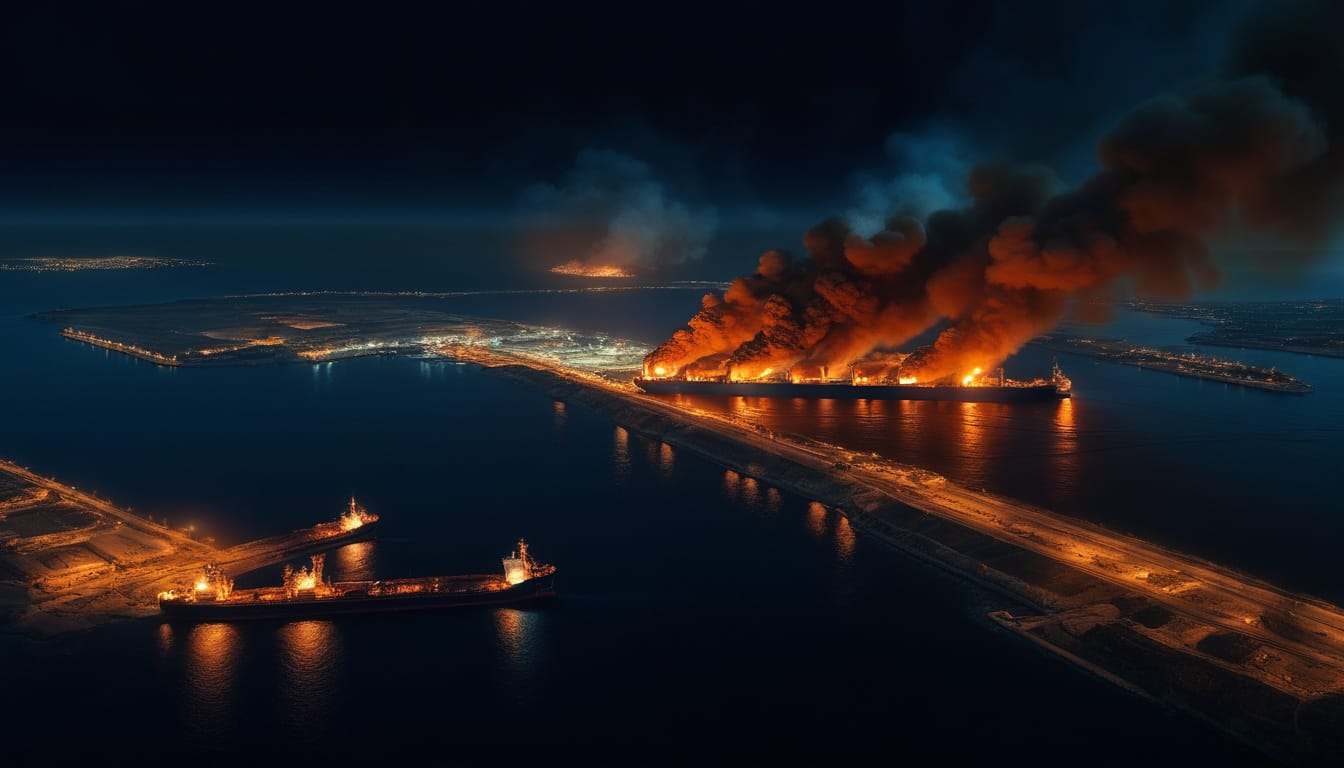
On July 29, a drone struck the Energos Winter — a US-managed liquefied natural gas storage and regasification unit — at Damietta port on Egypt's Mediterranean coast. The fire spread to the adjacent GasLog Salem LNG tanker. No group has claimed responsibility. But Iranian state television had named Damietta as a retaliation target two days earlier, citing Ukraine's strike on an Iranian vessel in the Caspian Sea. The New York Times quoted two Iranian officials saying the strike "was intended to demonstrate that if Iran chooses to escalate, global energy supplies and shipping could be hit much harder."
Egypt's exception is over. Damietta is 33 miles from the entrance to the Suez Canal.
Three Routes, Five Months
To understand why the Damietta strike matters so much, you need to understand the geography of how the world moves energy — and how each of the three major routes has been closed or threatened in sequence since February 28.
The Strait of Hormuz closed on the first day of the conflict. Approximately 20% of the world's seaborne oil trade and 20% of global LNG passed through it before the war. Ship transits collapsed from roughly 110 vessels per day to as few as two at the height of the conflict. Five months on, fewer than 10 ships per day are transiting — still only a tenth of pre-war volumes — under conditions of active IRGC interdiction.
The Bab el-Mandeb Strait and the Red Sea have been progressively closed by Iran's Houthi allies in Yemen throughout the conflict. Last week the Houthis declared a formal naval blockade of Saudi Arabia — the country whose exports most depend on the Red Sea route. Lloyd's of London widened its marine insurance "high risk" zone in the Red Sea this week to include more coastline adjacent to Saudi ports, reflecting the growing threat to vessels that thought they had found a Hormuz alternative.
The Suez Canal and the SUMED pipeline — Egypt's route — survived unscathed until July 29. Even as Hormuz and the Red Sea closed, Egypt's infrastructure continued to function. Saudi Arabia redirected some of its oil through the SUMED pipeline — a 200-mile overland route — offloading at the Red Sea terminal and retrieving cargo on the Mediterranean coast to avoid the Suez Canal's depth restrictions for fully loaded supertankers. This bypass was not cheap or efficient, but it worked. Until Wednesday.
Three routes. All three now closed or under active threat. Simultaneously.
Who Did This — and Why It Matters That We Don't Know
No group has claimed the Damietta strike. That is itself analytically significant.
The Houthis explicitly denied responsibility, issuing a statement on Telegram: "There is no truth to the rumors about Yemen targeting a ship in the port of Damietta." The denial is credible — the Houthis have always claimed their operations publicly and have no obvious strategic reason to deny an attack on a US-managed facility.
Windward Maritime Intelligence, whose tracking capabilities have been reliable throughout this conflict, assessed the Damietta strike as "a third front, separate from the Gulf and Red Sea" and noted that Iranian state television had named the port as a retaliation target two days earlier. The intelligence firm assessed the strike as "an Iranian-directed operation rather than a Houthi one."
Iran has officially denied involvement. Trump said it was "Iran-related." The New York Times Iranian officials described it as intended to demonstrate escalation capacity. One Egyptian security analyst told the Washington Times he ruled out Iran as the direct executor — suggesting a proxy operation.
The attribution question matters for a specific reason: if this was a direct Iranian operation conducted from Iranian territory or assets, it represents a qualitative escalation beyond the Gulf region — Iran striking a NATO-adjacent country's infrastructure 33 miles from the world's most strategically important canal. If it was a proxy operation by an as-yet-unidentified group, it signals the emergence of a new actor in the conflict with both the capability and the political direction to strike Egyptian infrastructure.
Either scenario is alarming. The difference is in the escalation implications for Egypt and for the canal itself.
Egypt: The Country That Tried to Stay Out
Of all the countries drawn into the orbit of this conflict — Bahrain, Kuwait, Qatar, Jordan, UAE, Oman, Iraq, Saudi Arabia — Egypt had been the most successful at staying out.
Cairo had long preferred "high-visibility joint exercises to integrated deployments," as a Washington Times Abu Dhabi source put it, which had "irritated Gulf capitals that felt Cairo reacted too slowly" to the conflict's expansion. Egypt's foreign minister met the UAE's Sheikh Abdullah in Abu Dhabi on July 21 — a diplomatic signal rather than an operational commitment. Cairo was watching, not participating.
The Damietta strike ended that posture. "Staying out has been exposed as a political preference, not an operational reality," the same Abu Dhabi source told the Washington Times. Targeting now follows US-linked economic and energy assets "regardless of the host nation's political posture."
Egypt's initial public response was characteristic of a country that does not want to be drawn into the conflict. The Petroleum Ministry's first statement said a fire had broken out aboard vessels at Damietta port and was immediately brought under control — no mention of a drone, no attribution, no condemnation. Only after Reuters and others published the drone attribution did Egyptian government statements acknowledge the attack, while carefully noting that no group had claimed responsibility and that investigations were continuing.
Cairo's reluctance to name the attacker is not surprising. Egypt has a complex relationship with Iran — it has no diplomatic relations with Tehran and is a US security partner, but it also depends on Suez Canal revenues for a significant share of its foreign exchange earnings and cannot afford to be seen as a combatant in a conflict that is already disrupting its most vital economic asset.
What the Suez Canal and SUMED Pipeline Actually Represent
The Suez Canal carries approximately 12-15% of global trade and around 8-10% of seaborne oil trade. For Saudi Arabia specifically, it has been the critical relief valve since Hormuz closed — allowing northbound oil exports via the Red Sea, the SUMED pipeline across Egypt, and the Mediterranean.
The SUMED pipeline runs 320 kilometres from Ain Sokhna on the Red Sea to Sidi Kerir on the Mediterranean, with a capacity of approximately 2.5 million barrels per day. It was specifically designed to allow supertankers — which are too large for the Suez Canal when fully loaded — to transfer their cargo for Mediterranean delivery. For Saudi Arabia, it has been indispensable.
The Damietta LNG complex at the other end of Egypt's Mediterranean coast is a separate but related piece of infrastructure. It is the terminal through which Egyptian and regional LNG flows to European markets. The Energos Winter that was struck is a floating storage and regasification unit — part of the infrastructure that allows LNG to be stored and converted for onward distribution. A successful strike on a floating storage unit at an LNG hub carries the risk of significant secondary explosion and fire.
None of this infrastructure has been struck before. Egypt has been the exception. The Damietta attack signals that the exception no longer applies.
The Insurance Cascade
The practical mechanism through which the Damietta strike immediately affects the global economy is insurance.
War risk insurance underlies every commercial decision about whether to route a vessel through any given waterway. When Lloyd's of London widens its "high risk" zone, premiums rise, and shipping operators face a simple calculation: does the economics of this route still work at the new premium level?
In the Strait of Hormuz, war risk premiums reached 16 times their pre-crisis level and effectively shut down commercial traffic for most operators. In the Red Sea, a similar dynamic unfolded as Houthi attacks intensified. Now, for the first time, Lloyd's has widened its Red Sea high-risk zone to include Saudi ports — and any further escalation toward the Suez Canal approaches will trigger a similar assessment of that route.
The economic consequences would be severe and rapid. The Suez Canal's current daily vessel throughput — roughly 40-50 ships per day — would fall sharply if operators are required to pay war risk premiums on Suez transits. European energy supplies, which have depended on the canal since both Hormuz and the Red Sea became hostile, would face a new and acute disruption.
Matthew Wright, principal freight analyst at Kpler, captured the stakes: "Disruption to the Suez Canal would have an almost immediate impact on prices. The inflationary pressure from longer voyages, higher freight, would be translated to consumers almost immediately."
The Damietta strike has not yet triggered war risk premium increases on Suez Canal transits. But it has demonstrated that the threat exists — and in insurance markets, demonstrated threat is the first step toward pricing that threat into premiums.
The Map That Has Changed
In January 2026, the world's energy shipping operated across three primary routes: the Strait of Hormuz, the Bab el-Mandeb and Red Sea, and the Suez Canal. Together they carried the majority of the world's seaborne oil and LNG trade to their primary markets.
Five months later, that map looks like this:
The Strait of Hormuz is effectively closed — operating at less than 10% of pre-war volumes under active IRGC interdiction, with mines still in the water and no completed clearance operation.
The Bab el-Mandeb and Red Sea are under active Houthi threat, with a formal Saudi naval blockade declared and Lloyd's widening its high-risk zone.
The Suez Canal and SUMED pipeline remain open but are now demonstrated targets, with a drone strike on the adjacent Damietta port this week and Iranian officials signalling the strike was intended as a warning of escalation capacity.
The Cape of Good Hope route — the alternative to all three — adds 14 days and significant cost to every voyage. It is the only route that has not been directly threatened. For now.
The Bottom Line
The Damietta strike is not, by itself, a catastrophic event. Two gas tankers were damaged. No one was killed. The port is operational. The Suez Canal was not directly struck.
But it represents something that has not existed before in this conflict: a direct demonstration that nowhere in the regional energy infrastructure is fully safe. The exception that Egypt represented — the country that stayed out, the route that kept working — has been punctured.
The Iranian officials quoted by the New York Times were explicit about the intent: this was a demonstration of capacity, not a maximum effort. "If Iran chooses to escalate," they said, "global energy supplies and shipping could be hit much harder."
That sentence is a message to Washington, to Gulf capitals, and to the global economy. The message is: the three-route closure you have been managing for five months is not the worst case. There is a worse case. And we have just demonstrated, at Damietta, that we can reach it.
Track vessel incidents, shipping routes, and energy market data in real time at the Hormuz Strait Monitor dashboard.
See the numbers in real time
Track oil prices, ship transits, insurance premiums, and strait status — updated every hour.