When the Taps Stop: The Infrastructure War That Neither Side Can Win
On the night of July 17, as US aircraft completed their seventh consecutive night of strikes on Iran, a seawater pumping station and power transformer at the Bunji desalination plant in Jask in southern Iran were, in the words of the Hormozgan Water and Wastewater Company's chief executive, "completely destroyed." Twenty villages lost water.
Simultaneously, across the Gulf, Kuwait announced that Iran had struck the Shuaiba power and water desalination complex — damaging multiple power generation units, sparking a fire, and prompting the government to urge citizens to ration electricity. Roughly 90 percent of Kuwait's drinking water comes from desalination. Hundreds of thousands of people woke up to a reduced supply.
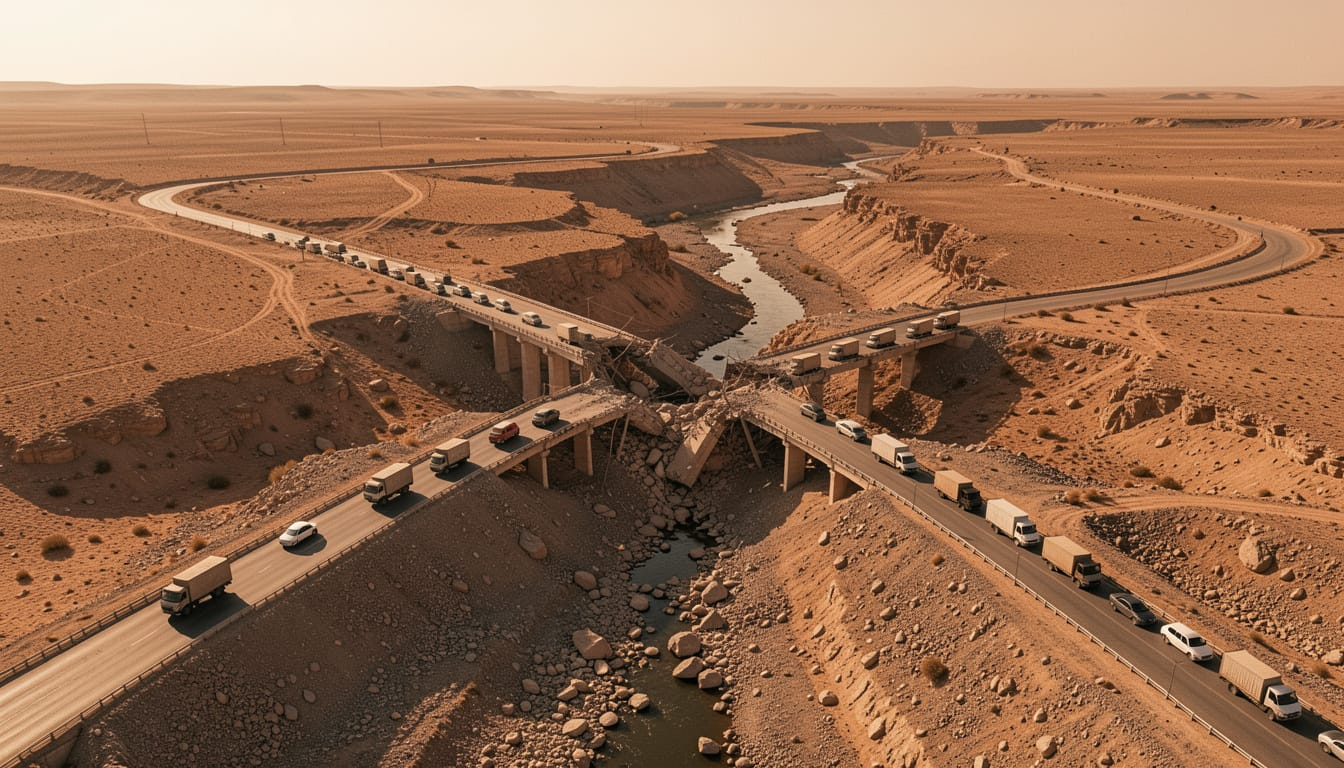
In the same 24-hour window, US strikes destroyed bridges and railway lines disrupting the main highway toward Bandar Abbas. Iranian strikes targeted power and water infrastructure across five Gulf states. Iranian Foreign Minister Araghchi accused Washington of "criminal intent to commit heinous crimes." The Kuwaiti Foreign Ministry condemned "heinous Iranian aggression" constituting "a grave breach of international law."
Both sides are right. Both sides are doing it. That is the defining characteristic of what this conflict has now become.
How We Got Here
The shift to infrastructure targeting did not happen suddenly. It followed a logic that both sides telegraphed — and that neither side's legal arguments have been able to contain.
Trump threatened it explicitly on Fox News: "I'll save the energy targets for last." He said bridges and power plants could be struck if Iran refused to negotiate. On the Iranian side, the IRGC warned in early July that any continuation of US strikes would result in attacks on "vital infrastructure across the Gulf region." Both sides announced what they were going to do. Then they did it.
The first desalination plant strike in this conflict was actually on March 8 — an Iranian drone hit a plant in Bahrain, causing material damage and injuring three people. A similar strike hit Kuwaiti infrastructure in late March, killing one Indian worker. These were treated at the time as tactical strikes at the margins of the conflict. They were not marginal. They were the first moves in an escalation sequence that has now produced what Foreign Policy describes as a conflict in which "attacks on bridges, power plants, and desalination facilities could be considered war crimes" — on both sides.
The Shuaiba complex in Kuwait has now been struck twice since March. The Bunji plant in Iran is destroyed. Bridges near Bandar Abbas are down. Railway lines in southern Iran are severed. And Trump has said the energy targets — refineries, power plants, the infrastructure that keeps Iranian society functioning — are coming later.
What International Law Actually Says
The legal framework governing infrastructure strikes in armed conflict is clear in its principles and difficult in its application.
Article 54 of Additional Protocol I to the Geneva Conventions prohibits attacking "objects indispensable to the survival of the civilian population" and specifically names drinking water installations and foodstuffs. Customary International Humanitarian Law Rule 54 — binding regardless of whether states have ratified Additional Protocol I — codifies the same prohibition. The United States has not ratified Additional Protocol I, but is generally held to be bound by its customary law provisions.
The prohibition is not absolute. A military commander can argue that a desalination plant is a legitimate target if it serves a dual civilian-military function — for example, if it supplies water to a military base. A bridge can be targeted if it is being used to move troops or supplies. The legal standard is military necessity weighed against proportionate civilian harm, assessed at the moment of the strike.
In practice, however, as Al Jazeera noted in its legal analysis published Friday, "whether the strikes violate international humanitarian law depends on factors that are often difficult to determine while a conflict is ongoing." The fog of legal argument is as thick as the fog of war.
What is not legally ambiguous is the deliberate targeting of infrastructure with no plausible military function — residential neighbourhoods, food silos, civilian water supplies. Iranian officials say strikes have hit all of these. The US says it is targeting military logistics infrastructure. Iran has filed a letter with the United Nations calling the attacks "serious international crimes." The UN has not yet formally adjudicated the question, and is unlikely to — Russia and China would veto any Security Council action.
What Foreign Policy's legal correspondent identified as the key threshold was crossed this week: the conflict has moved from strikes on military targets that incidentally damage civilian infrastructure, to strikes on civilian infrastructure that is incidentally near military targets. The direction of the legal argument has reversed.
For a full breakdown of the legal framework and a target-by-target assessment of every strike in this conflict, see our International Law & the Hormuz Conflict explainer page.
The Water Dimension
The Persian Gulf is one of the most water-stressed regions on earth. Desalination is not a supplementary system — it is the backbone of daily life for approximately 50 million people across the Gulf Cooperation Council states.
Gulf states produce 40 percent of the world's desalinated water. Saudi Arabia's four largest desalination complexes — Ras Al-Khair, Jubail, Shoaiba, and Yanbu — collectively serve approximately 20 million people. Kuwait depends on desalination for more than 90 percent of its drinking water. Qatar, Bahrain, and the UAE are similarly dependent. These plants are, as the Center for Strategic and International Studies identified in a 2026 analysis, "as exposed to Iranian weaponry as any civilian infrastructure that has been targeted."
The vulnerability is extraordinary in scale. Desalination plants are technically complex, dependent on specialised parts and skilled operators, and highly energy-intensive. A strike on the power grid, fuel supply, or associated logistics can shut down water service as effectively as a direct hit on the plant itself. Because supply is centralised, a successful strike against a small number of facilities can produce a humanitarian crisis affecting millions within days.
Foreign Policy's March analysis — published when the first desalination strikes were being dismissed as tactical incidents — put the stakes plainly: "They experience the impact when the taps stop."
Taps are stopping. In 20 villages in southern Iran as of this morning. In Kuwait, where rationing has been imposed. In Bahrain, where a March strike is still affecting capacity. And the escalation ladder has not reached the top: Trump has explicitly reserved Iran's energy sector — which includes the refineries and power plants that run everything else — for later.
The Bridge Strikes: Cutting Iran Off From Itself
The US strikes on bridges and roads near Bandar Abbas serve a clearer military rationale than the desalination strikes — Bandar Abbas is the city closest to the narrowest point of the Strait of Hormuz, Iran's primary naval base for IRGC operations in the strait, and the logistics hub through which mine-laying equipment, fast boats, and maritime surveillance assets flow.
Severing road and rail connections to Bandar Abbas degrades Iran's ability to resupply and reinforce its Hormuz operations. The military logic is coherent. But footage and images published by Iranian state media show heavily damaged bridges and railway lines in civilian communities, residential neighbourhoods reported struck, and an AP photograph of the aftermath in Bandar Khamir county that shows a destroyed bridge over what appears to be a civilian road — not a military access route.
Iran's accusation — that the US is targeting civilian infrastructure — and the US position — that it is targeting military logistics — are both partially true. The bridge between them, so to speak, is the question of which use was primary. Under IHL's proportionality standard, a military commander must assess whether the anticipated military advantage outweighs the foreseeable civilian harm. That assessment is almost never made public, and is almost never independently verifiable during an active conflict.
What is publicly verifiable is that 10,000 people in southern Iran lost water overnight when the Bunji pumping station was destroyed. Whether the station had any military function has not been established.
The Tit-for-Tat Logic That Makes This Hard to Stop
Infrastructure targeting in armed conflict follows a particularly dangerous tit-for-tat logic. Once one side strikes civilian infrastructure — even with arguable military justification — the other side claims both moral permission and practical incentive to do the same. The cycle is self-reinforcing and extremely difficult to break without a ceasefire that both sides observe.
Iran's attacks on Gulf desalination plants are following exactly this logic. After the US struck Iranian water and transport infrastructure, Iran warned it would "respond in kind by striking civilian infrastructure across the Gulf region." The IRGC has made good on that warning. Kuwait's Shuaiba complex — struck previously in March and again this week — is becoming a recurring target in a retaliatory cycle that has no natural ceiling.
Foreign Policy noted a historically significant pattern: "The last time Iran hit a desalination facility in Kuwait, the United States agreed to the war's first truce just a week later." The March desalination strike on Kuwait preceded the April 8 ceasefire by approximately a week. The Shuaiba strike this week may carry the same signal — that Iran is communicating to Gulf states the cost of hosting US military operations, in the hope that Gulf diplomatic pressure on Washington produces a new negotiating opening.
If that is the strategic logic — and it fits the IRGC's pattern throughout this conflict — then the infrastructure strikes are not an escalation beyond rational control. They are pressure applied at a point of maximum vulnerability, designed to produce a political outcome. Whether they will produce that outcome, or simply accelerate the escalation cycle, depends entirely on whether Gulf states and Washington interpret the signal the way Iran intends.
What Comes Next
Trump has been explicit. Energy targets — refineries, power plants — are coming later. He has said it publicly, repeatedly, and specifically. If the current pattern holds, the sequence is bridges and transport now, water and power next, energy infrastructure after that.
Each step carries a higher humanitarian cost and a higher legal risk. Bridges affect military supply lines and civilian transport. Water plants affect military bases and civilian survival. Power plants and refineries affect everything — military operations, hospitals, factories, the supply chains that keep food cold and medicines potent.
Iran has made a parallel threat. "We will not leave any act of aggression unanswered," Deputy FM Gharibabadi said Friday. The Gulf's desalination infrastructure — concentrated, exposed, and serving tens of millions of people — is the primary Iranian leverage point in that threat. Saudi Arabia's four giant plants remain largely untouched. Ras Al-Khair alone serves approximately 7 million people.
The infrastructure war has begun. The escalation ladder still has rungs above where both sides are standing today.
The Bottom Line
Both sides have now crossed into deliberate infrastructure targeting. Both sides have legal arguments for why their own strikes are justified and the other side's are criminal. Both sides are right that the other side's strikes are hitting civilians. Both sides are choosing to continue.
The taps in 20 villages in southern Iran are off this morning. The power plant in Kuwait is damaged. The bridges near Bandar Abbas are down. Fifty people have been killed in US strikes since July 6 alone.
The question this conflict has now raised is not whether infrastructure will be targeted — it already is. The question is how far up the escalation ladder both sides are prepared to go before the humanitarian consequences become the political pressure that forces a new negotiation.
The answer, so far, is further than anyone expected.
The Damietta strike on July 29 confirmed that warning. Read our full analysis of the three-route closure: When All Three Routes Close.
Follow vessel transit data, military exchange tracking, and diplomatic developments in real time at the Hormuz Strait Monitor dashboard.
See the numbers in real time
Track oil prices, ship transits, insurance premiums, and strait status — updated every hour.