Eight Tankers in Seven Days: How the Blockade Became a Tanker War
ANALYSIS · September 9, 2026 · 7 min read
For most of the past six months, the war at sea has had a recognizable shape. Iran attacked commercial shipping to punish vessels for using routes it hadn't approved. The US enforced a naval blockade against Iranian ports, disabling ships that tried to run it. Both sides operated within something like a defensive logic, even when the results were violent.
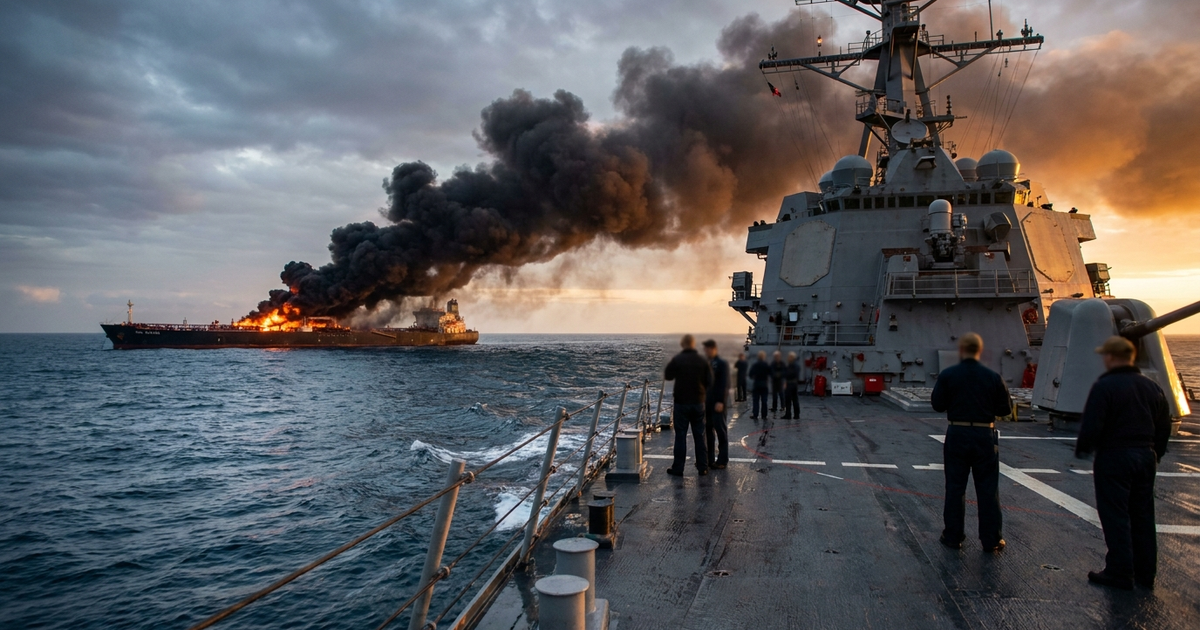
That logic broke down this week. On September 5, Iran fired ballistic missiles directly at a US aircraft carrier and a guided-missile destroyer — not a commercial vessel, not a blockade-runner, an active US Navy warship. Within hours, the United States had sunk one Iranian tanker and disabled two more. Three days later it happened again: a second failed Iranian missile attempt against a US warship, followed by five more Iranian tankers destroyed in a single day. By Wednesday, CENTCOM was crediting itself with 10 Iranian tankers destroyed in a week, and describing them not as blockade-runners but as a "multibillion-dollar shadow network" funding the IRGC. This is no longer a blockade. It is a tanker war, and it has its own internal logic that is worth taking seriously on its own terms.
The Week in Numbers
Start with what's confirmed. On September 5, US forces struck the M/T Kylo, the M/T Downy, and the M/T Stark 1 in direct retaliation for the IRGC's missile attack on the carrier and destroyer that morning. CENTCOM confirmed the following day that the Kylo had sunk — the first tanker lost in direct combat this war. Three days later, on September 8, the IRGC attempted a second missile strike on a US warship; CENTCOM says it failed, as the first one had. The retaliation this time was larger: five tankers, four in the Gulf of Oman and a fifth, the M/T Derya, near Kharg Island. Iran's own state media confirmed the Kharg Island strike and said the crew evacuated safely.
That is eight named vessels in four days. CENTCOM's own Wednesday statement rounds the week's total up to 10.
The doctrine behind this was stated plainly by CENTCOM commander Admiral Brad Cooper after the first exchange: "If you shoot at two of our ships, we will impose an even higher economic cost — taking out three of yours." Defense Secretary Hegseth made the same point on X in blunter terms over the weekend: "if Iran shoots at U.S. ships, we will destroy (and sink) their oil tankers... Iran has no navy or air force." This is a deterrence formula with an explicit exchange rate built in, and this week it was applied twice, each time at a multiple of the provocation.
A Different Kind of Target
What's changed isn't just the tempo. It's the description of what's being hit. Throughout the blockade phase, disabled tankers were framed as sanctions violators — vessels attempting to move Iranian oil in defiance of the naval blockade. This week, CENTCOM described the destroyed tankers as part of a "multibillion-dollar shadow network that funds the IRGC," language that recasts the targets from cargo to infrastructure. Sinking or disabling a tanker under that framing isn't primarily about stopping one voyage; it's about degrading a financing system.
That's a meaningfully larger war aim than "keep the strait open," and it tracks with the broader shift we noted after September 1, when the US struck two Iranian government tankers directly under a new "tanker for tanker" retaliation doctrine rather than only disabling vessels caught running the blockade. This week extends that logic from retaliation into something closer to attrition — not one tanker for one attack, but a sustained campaign against the fleet itself, triggered by any Iranian move against a US warship.
Iran's side of this is harder to pin down, because its own claims have grown increasingly difficult to verify. On the same day CENTCOM announced its week's tally, the IRGC claimed to have struck two US Navy destroyers, causing "significant damage." CENTCOM's denial was immediate and unusually blunt: "This is completely FALSE. No U.S. Navy warship has been struck; all IRGC attempted attacks failed." The IRGC separately claimed action against "2 American vessels and 8 tankers... causing great damage," plus strikes on 10 more "violating ships" — a sweeping account that no operator, flag state, insurer, or independent maritime authority has corroborated. This pattern — expansive Iranian claims of successful strikes, met with flat US denials and no third-party confirmation either way — is now roughly two weeks old and shows no sign of resolving. It leaves outside observers, including us, in the position of being unable to independently verify what's actually landing on either side, only what each government says landed.
Rhetoric Escalating Alongside the Strikes
The words accompanying this week's strikes have escalated in step with the strikes themselves. Iran's parliament speaker and chief negotiator, Mohammad Bagher Ghalibaf, responded to Hegseth's tanker threat by naming American energy infrastructure directly as a target: "the oil and gas production chain here is sprawling, accessible, and exposed... Strike our assets, and you get struck. We've already proven it. Ask the bases that are no longer viable." That's not a new claim of capability so much as an explicit statement of intent — moving the stated theater of retaliation from Iran's own coastline to wherever American energy interests in the region are exposed.
By Wednesday, Iranian officials were also describing the past week's attacks — including the strikes on Jordan and on US Navy vessels — as "defensive," a notable reframing from Ghalibaf's own "era of proportionate responses is over" comment just three days earlier. Whether that's a genuine softening or simply a public-messaging adjustment aimed at avoiding the appearance of unprovoked aggression is not something we can determine from outside.
What Doesn't Fit the Escalation Story
It would be a mistake to read this week as pure, uninterrupted escalation, because two things are happening in parallel that cut against that read. Oil prices did cross $100 a barrel on Wednesday for the first time since July 24 — a real signal of market anxiety. But global oil prices have crossed thresholds like this before during this war and come back down. And on the diplomatic side, Qatar's prime minister met with Chinese Foreign Minister Wang Yi in Beijing on September 8 specifically to discuss the strait's closure — the first real sign of Chinese diplomatic involvement in this file. Qatar's position, notably, split the difference between the US and Iran: unconditional reopening as the top priority, explicitly rejecting both Iran's right to set terms and charge fees and the use of the waterway as leverage by any party.
That a mediation track is still active — with a new outside power now showing interest — even as the military exchange intensified is a genuine tension in this week's story, not a footnote to it. Wars that escalate militarily while diplomatic tracks stay open aren't unprecedented, but they are harder to characterize than either a straightforward path to peace or a straightforward path to further war.
Where This Leaves Things
The honest assessment is that the tanker-war phase we're now in has its own momentum, distinct from the blockade it grew out of. The trigger-and-response cycle — an Iranian move against a US warship, a proportionally larger US strike on Iranian tankers — has repeated twice in four days with the same shape both times. If that pattern holds, the tanker fleet CENTCOM describes as an IRGC financing network is being degraded at a pace that outstrips anything in the war's earlier phases, and Iran's own account of the exchange has grown less and less verifiable at exactly the moment when accurate information matters most. Whether Iran adjusts its behavior in response to that cost, escalates to find something the US isn't willing to trade tankers for, or the Beijing-brokered diplomatic track finds room to reassert itself, is not yet visible from where we sit.
See the numbers in real time
Track oil prices, ship transits, insurance premiums, and strait status — updated every hour.