The Ceasefire That Keeps Collapsing: 72 Hours That Shook the Hormuz Crisis
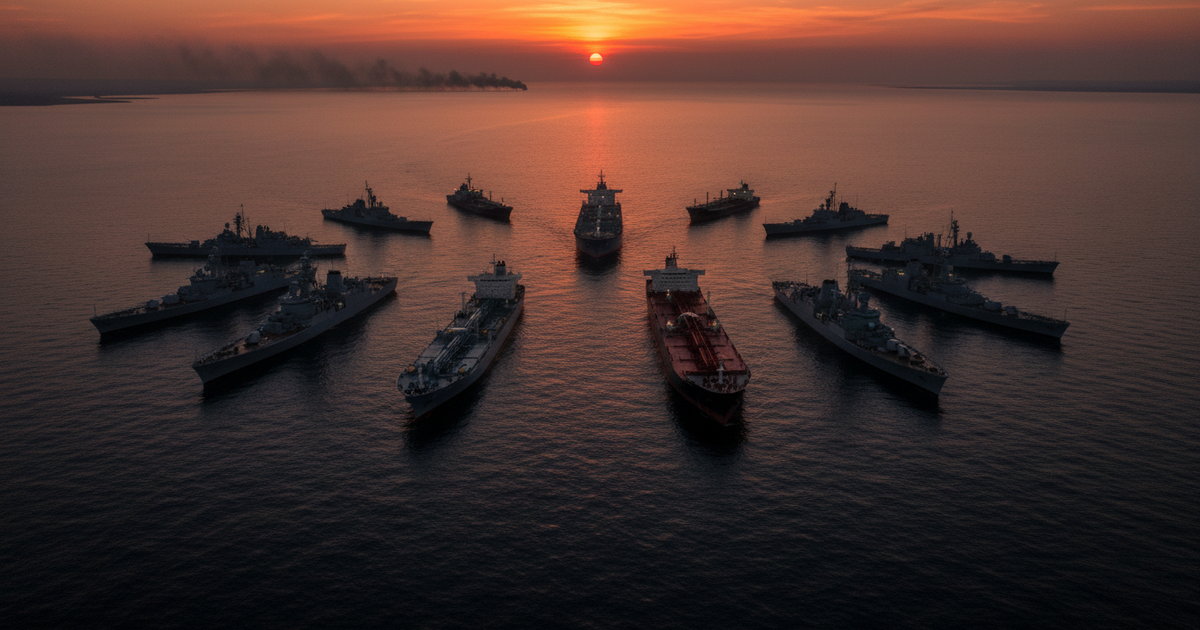
For a brief moment on Friday, April 17, it looked like the world's worst energy crisis in half a century was about to end.
Iran's Foreign Minister Abbas Araghchi posted on X that the Strait of Hormuz was "fully open and ready for full passage." Oil markets reacted instantly — Brent crude tumbled more than 10%. In Washington, President Trump was ebullient, posting "Thank you!" in response to Tehran's announcement. In Islamabad, diplomats were preparing for what looked like the final sprint to a deal. After nearly two months of blockade, the math finally seemed to be working.
Seventy-two hours later, three more commercial vessels had been fired upon, the U.S. Navy had seized an Iranian cargo ship in the Gulf of Oman, and the strait was shut again. The ceasefire — technically still in place, now extended indefinitely — is holding in name only.
What happened, and what does it tell us about where this crisis is heading?
The Setup: A Fragile Truce
The two-week ceasefire agreed on April 8 was always built on a fundamental contradiction. Iran interpreted the truce as requiring the U.S. to lift its naval blockade of Iranian ports — a blockade Washington began enforcing on April 13. The U.S. viewed the ceasefire as covering military strikes only, with the blockade as a separate economic pressure mechanism designed to force Iran's hand at the negotiating table.
That gap never closed. It simply went unaddressed long enough for both sides to declare victory in public while their negotiators quarrelled in private.
Iran's chief negotiator and Parliamentary Speaker, Mohammad Bagher Ghalibaf, had warned as early as April 15 that "reopening the Strait of Hormuz is impossible" as long as the U.S. naval blockade continued. The warning went largely unheeded in Western markets, which were pricing in a deal.
Friday: The Opening That Wasn't
When Araghchi's announcement came on Friday April 17, the coincidence was notable: a truce had also taken effect in Lebanon that same day, and the overall diplomatic atmosphere was warmer than it had been in weeks. Trump's public enthusiasm seemed to signal that Washington, too, believed the pieces were finally in place.
What followed was a masterclass in the gap between announcements and reality.
At least nine vessels attempted to pass through the strait in the hours after Iran's declaration — a tentative, cautious trickle, not the flood of traffic the global economy desperately needed. Ships that had been anchored in the Gulf for weeks weighed anchor and pointed their bows toward the open ocean.
Then, on Saturday morning, the guns opened up.
Saturday: Ships Under Fire
Iranian Revolutionary Guard Corps (IRGC) gunboats fired on at least two vessels attempting to transit the strait. The targets were apparently Indian-flagged ships; New Delhi promptly lodged a formal complaint with Tehran. A French vessel operated by CMA CGM reported receiving warning shots. A UK-flagged freighter was also targeted — a detail that prompted a furious response from Trump, who posted on Truth Social: "Many of them were aimed at a French Ship, and a Freighter from the United Kingdom. That wasn't nice, was it?"
Iran's position was unambiguous: it would not allow commercial traffic through a waterway that it controlled while the U.S. simultaneously blocked Iranian ships from their own ports. "It is impossible for others to pass through the Strait of Hormuz while we cannot," Ghalibaf said on state television. The Strait was, in effect, closed again — less than 24 hours after the announcement that had briefly moved global markets by 10%.
By Saturday evening, tracking data showed vessel movement through the strait had fallen back to near zero.
Sunday: The U.S. Seizes a Ship
Washington's response came on Sunday, and it escalated the confrontation significantly.
The U.S. Navy intercepted the M/V Touska — a sanctioned Iranian cargo ship over 900 feet in length — in the Gulf of Oman. According to Trump, the vessel was given "fair warning to stop" but refused. U.S. forces then disabled the ship's engines and Marines boarded and seized the vessel. Trump described the ship as having been trying to "run the blockade." Iranian officials condemned the seizure as "armed piracy" and vowed retaliation.
Trump, simultaneously, threatened to "knock out every single Power Plant, and every single Bridge, in Iran" if Tehran failed to accept a deal, calling the weekend's events "a Total Violation of our Ceasefire Agreement."
For markets, it was a sobering reminder that the ceasefire — whatever it still meant — had not produced peace.
The Week After: Extension With No Resolution
With the ceasefire set to expire on April 22, Trump announced he was extending it indefinitely, citing Pakistan's request as mediator and giving Iran time to "come up with a unified proposal." The U.S. naval blockade would continue regardless.
Iran's response came within hours: the IRGC attacked three more commercial ships in the strait, seizing two of them. The IRGC said the vessels were linked to Israel — a claim it offered without evidence — and warned that "disrupting order and safety in the Strait of Hormuz is our red line."
As of this writing, U.S. Central Command reports it has turned around 31 vessels attempting to enter or exit Iranian ports since the blockade began. Fewer than a handful of commercial ships have transited the strait in the past 72 hours.
Why a Deal Is Still So Far Away
The core problem is structural. Both sides have defined "ceasefire" in incompatible ways, and neither appears willing to move first.
Iran's position is that the U.S. naval blockade is itself an act of war — a direct violation of the truce. Unless the blockade lifts, Iran will continue to control access to the strait. "A full ceasefire only has meaning if it is not violated by a naval blockade," Ghalibaf said.
Washington's position is the mirror image: the strait must be open before any blockade discussion can happen. The U.S. views the blockade as leverage, not a violation.
The deeper sticking points are even harder. Vice President Vance has said the first round of ceasefire talks broke down because Iran would not commit to forgoing a nuclear weapon. Iran's negotiators, meanwhile, insist they need a "guarantee that this cycle of war, ceasefire and negotiation will not be repeated" — in other words, structural security assurances that Washington shows little appetite for providing.
Peace talks in Islamabad, Pakistan, were expected to resume this week. Iranian state media has since reported there is "no clear prospect" for talks under current conditions.
What the Markets Are Watching
The brief Friday opening — and the 10% crude selloff that accompanied it — demonstrated how sensitive markets remain to any sign of genuine progress. It also demonstrated the risk of false dawns.
Experts have cautioned that even a genuine deal would not immediately restore flows. Cumulative supply disruption has now exceeded half a billion barrels. Stranded vessels, elevated insurance premiums, and the operational reality of ships rerouted to the Cape of Good Hope mean that restoring normal throughput through the strait will take weeks, if not months, after any agreement. For a deeper look at what a prolonged closure means for prices, reserves, and global supply chains, see our analysis of what happens when the strait is blocked.
"If we actually got the strait open, we would probably see another $10 to $20 a barrel immediate rout," one commodity analyst noted — but the market would then have to grapple with the structural damage already done to supply chains, long-term contracts, and refinery schedules.
The countries most dependent on Hormuz oil — Japan, South Korea, and India — are watching especially closely. For these economies, each day of closure deepens a supply crisis that strategic reserves alone cannot solve.
The Bottom Line
The events of April 17–22 revealed something important: neither side is yet in enough pain to make the concessions a deal requires. Iran is controlling the strait. The U.S. is controlling Iranian ports. Both are absorbing the costs of stalemate while betting that the other will blink first.
The ceasefire label still attached to this conflict is doing real work — it keeps the door to diplomacy technically open and prevents a full return to airstrikes. But it is not, at this point, producing peace. It is producing a slow-motion economic crisis, 13 million barrels per day of supply shut-in, and a waterway where commercial ships are still being fired upon.
Until the structural disagreement over the blockade is resolved — or until one side's economic position becomes untenable — the pattern of the past week is likely to repeat: brief openings, market rallies, and then guns.
Track real-time ship movements, crude prices, and crisis developments on the Hormuz Strait Monitor dashboard.
See the numbers in real time
Track oil prices, ship transits, insurance premiums, and strait status — updated every hour.