Strait of Hormuz vs Suez Canal: Comparing the World's Oil Chokepoints
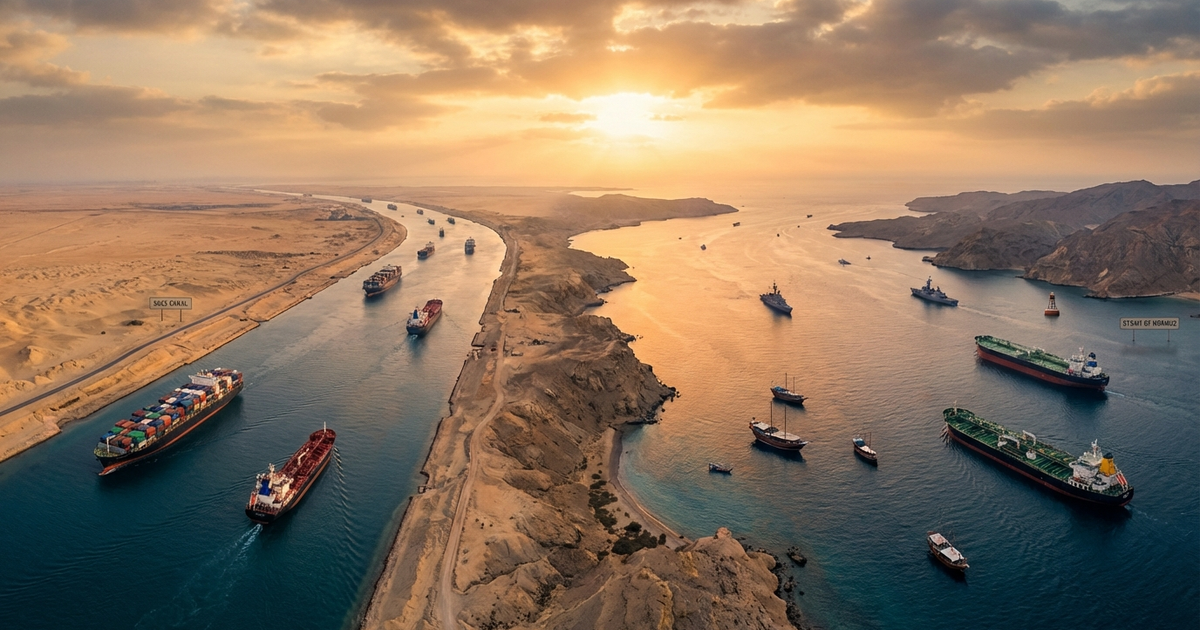
The Strait of Hormuz and the Suez Canal are the two most important maritime chokepoints for global energy trade. Both are narrow, both are strategically vital, and both have been disrupted in recent memory. But they differ in scale, vulnerability, and the consequences of closure.
By the numbers
| Strait of Hormuz | Suez Canal | |
|---|---|---|
| Width | 33 km (21 mi) at narrowest | 205 m (673 ft) at narrowest |
| Oil throughput | ~20 million bbl/day | ~5–6 million bbl/day |
| Share of global oil | ~21% | ~7–8% |
| LNG throughput | ~25% of global LNG | ~8% of global LNG |
| Vessels daily | ~60 | ~50–80 |
| Bypass options | Pipelines (~6.5M bbl/day) | Cape of Good Hope |
| Last major disruption | 2026 (current crisis) | 2024 (Houthi attacks), 2021 (Ever Given) |
The most striking difference is scale. Hormuz carries roughly four times as much oil as the Suez Canal. A closure at Hormuz removes three to four times more crude from global markets than a Suez disruption.
Different kinds of vulnerability
Hormuz: geopolitical chokepoint
The Strait of Hormuz is primarily a geopolitical risk. Iran's coastline runs along the northern shore, and its naval forces — including fast attack craft, mines, and anti-ship missiles — could theoretically close or severely disrupt the strait.
The risk isn't piracy or accidents — it's state-level military action. This makes Hormuz a fundamentally different kind of vulnerability than the Suez Canal. You can't solve it with better navigation or bigger tugboats.
Suez: operational and security risks
The Suez Canal faces a wider range of threats, but each is individually less severe than the Hormuz scenario:
- Operational accidents. The 2021 Ever Given grounding blocked the canal for six days, disrupting $9.6 billion in daily trade. The canal is essentially a ditch — one stuck ship blocks everything.
- Regional conflict. The 2024 Houthi attacks on commercial shipping in the Red Sea forced most container lines to reroute via the Cape of Good Hope, effectively making the canal unusable even though it was physically open.
- State closure. Egypt closed the Suez Canal during the 1956 Suez Crisis and the 1967 Six-Day War (it remained closed until 1975). Egypt controls the canal and could theoretically close it again, though the economic self-harm would be enormous since canal fees are a major revenue source.
Bypass options compared
Hormuz bypasses
Two major pipeline systems can bypass the Strait of Hormuz:
- Saudi Petroline (East-West Pipeline): ~5 million bbl/day capacity from the Eastern Province to Yanbu on the Red Sea.
- UAE ADCOP pipeline: ~1.5 million bbl/day from Abu Dhabi to Fujairah on the Gulf of Oman.
Combined, these pipelines can move about 6.5 million barrels per day — roughly a third of normal Hormuz throughput. There is no bypass for LNG.
Suez bypasses
The Suez Canal has one bypass: the Cape of Good Hope. Ships sail south around Africa, adding approximately 10–15 days and $300–800K per voyage. Unlike Hormuz pipelines, this alternative has unlimited capacity (it's open ocean), but the extra sailing time ties up vessels and effectively reduces global shipping capacity.
The SUMED pipeline across Egypt can move about 2.5 million barrels per day from the Red Sea to the Mediterranean, providing a partial pipeline bypass for oil — but only if the oil can first reach the Red Sea.
Economic impact of closure
Hormuz closure impact
A full Hormuz closure would be the largest oil supply disruption in history:
- Removes ~20 million bbl/day from the market (vs. 4.4M bbl/day in the 1973 embargo)
- Oil prices would likely spike to $150–200+ per barrel
- Global GDP impact estimated at 3–5% in the first year
- Triggers immediate strategic petroleum reserve releases worldwide
- LNG markets simultaneously disrupted, affecting power generation across Asia
Suez closure impact
A Suez disruption is serious but more manageable:
- Removes ~5–6 million bbl/day from the shortest route, but the oil can still arrive via the Cape
- Oil price impact is typically a 10–20% premium, not a doubling
- The main cost is in shipping rates and delays, not physical oil shortage
- Container shipping (consumer goods) is actually more affected than oil, since container schedules are tighter
The 2024 Houthi crisis proved this out: oil prices rose modestly (~5–10%), while container shipping rates roughly doubled. The world managed because the oil was still flowing — just taking a longer route.
Which matters more?
Hormuz is the more consequential chokepoint by a significant margin. Three factors make it uniquely dangerous:
- Scale. Four times more oil than Suez, plus irreplaceable LNG flows.
- No maritime alternative. Suez-bound ships can go around Africa. Hormuz-bound ships are loading at the chokepoint — the oil originates inside the Persian Gulf. There's no maritime detour; only pipelines can bypass it, and they have limited capacity.
- State military threat. The Suez can be blocked by accidents or non-state actors, but only the Hormuz faces a credible state-level military closure scenario.
That said, the Suez has been disrupted more frequently in recent years. Its operational vulnerabilities (groundings, regional conflict) are easier to trigger than a full Hormuz military closure, even if the consequences are less severe.
Could both close at once?
This is the nightmare scenario for energy markets. A simultaneous disruption at Hormuz and Suez would cut off the shortest oil routes from the Middle East to both Europe and Asia. Saudi oil sent via the Petroline to the Red Sea would be stranded if the Suez were also blocked.
The probability is low — the disruptions would need to be caused by different actors or a broader regional conflict — but it's not zero. The 2024 Houthi crisis (Red Sea/Suez) and the current 2026 Hormuz crisis have occurred within two years of each other, highlighting how interconnected Middle Eastern maritime security risks are.
Key takeaways
- Hormuz is about four times more important than Suez for oil, and far more important for LNG
- Suez is more frequently disrupted but has a clear bypass (Cape of Good Hope)
- Hormuz has pipeline bypasses but they cover only about a third of normal flow
- A Hormuz closure triggers a global energy crisis; a Suez closure triggers higher shipping costs
- Both chokepoints are increasingly contested, and the risk of simultaneous disruption deserves serious attention
See the numbers in real time
Track oil prices, ship transits, insurance premiums, and strait status — updated every hour.