Two Coalitions, One Strait: Why Washington Just Blinked
For weeks, President Trump insisted the United States needed no help reopening the Strait of Hormuz. "We do not need the help of anyone," he said in mid-March, after every NATO ally he approached declined to join the active conflict. The message was clear: this was America's war, and America would handle the strait on its own terms.
That position quietly collapsed on April 29.
On that date, the State Department sent an internal cable to every U.S. embassy in the world, instructing diplomats to pitch foreign governments on joining a new U.S.-led maritime coalition called the "Maritime Freedom Construct." Diplomats were asked to have their pitches delivered by Friday. The reversal — from "we need no help" to "we invite your country to join" — took less than seven weeks.
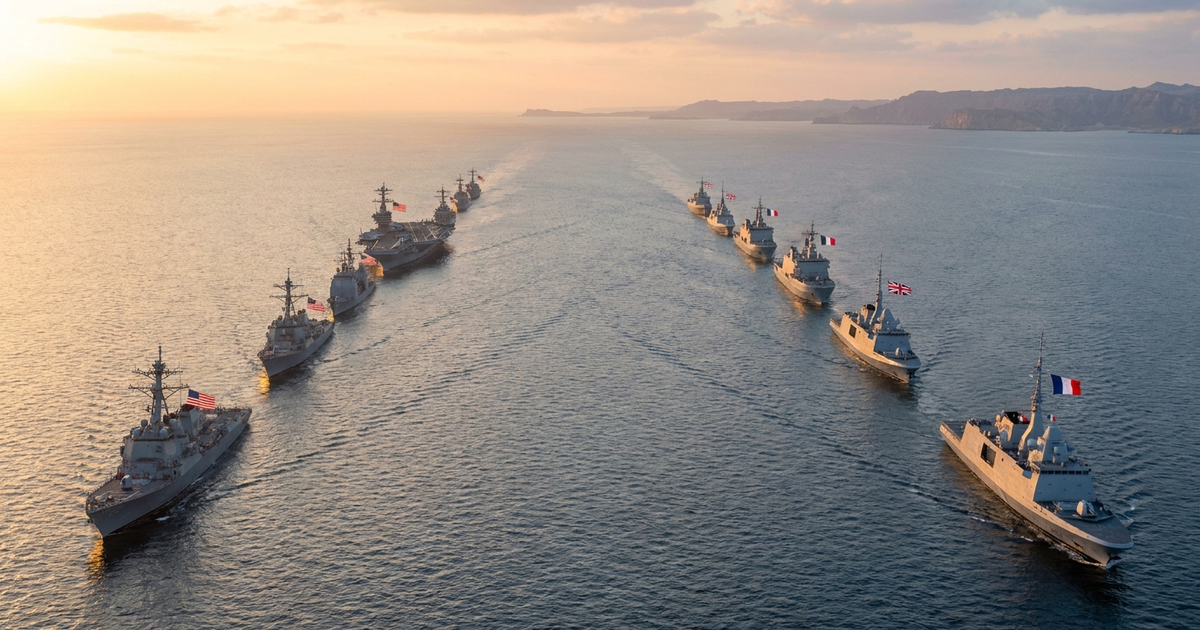
The MFC is now set to operate alongside, and in parallel with, the 38-nation Northwood coalition led by the UK and France. Two coalitions, structurally independent, theoretically complementary, recruiting from some of the same pool of potential partners. The question is whether this is a genuine coordination effort or the beginning of a diplomatic competition that complicates rather than accelerates the reopening of the world's most important energy waterway.
What the Maritime Freedom Construct Actually Is
The MFC is, in important respects, a different kind of coalition from the one assembled at Northwood.
Where Northwood is focused on future military deployment — mine-clearing vessels, naval escorts, force packages ready to move when a ceasefire holds — the MFC is primarily a diplomatic and information-sharing architecture. According to the State Department cable, it will take steps to "ensure safe passage, including providing real-time information, safety guidance, and coordination to ensure vessels can transit these waters securely." The operational component sits at CENTCOM headquarters in Florida, providing real-time maritime domain awareness and direct communication with vessels attempting to transit the strait.
Participation is deliberately flexible. Countries do not need to commit troops or naval assets. They can contribute through diplomatic backing, intelligence sharing, sanctions alignment, or any other form of support they choose. U.S. officials have gone out of their way to emphasise that nations are "not required to divert resources from existing maritime commitments" — a pointed contrast to Trump's earlier demands that allies send warships.
The MFC was authorised by Secretary of State Marco Rubio and is described in the cable as a "US-led" initiative. It excludes countries considered adversarial: Russia, China, Belarus, and Cuba are explicitly not invited. That exclusion is geopolitically significant — China in particular is one of the largest beneficiaries of Hormuz access, and its absence from both the MFC and the Northwood framework means the coalition architecture has a significant gap at the centre of the problem it is trying to solve.
The Reversal That Took Seven Weeks
To understand the significance of the MFC's launch, it helps to trace the arc of how Washington got here.
In mid-March, Trump publicly demanded that NATO, China, Japan, and South Korea send military vessels to help secure the strait. Every one of them declined. German Defence Minister Boris Pistorius spoke for many: "This is not our war. We have not started it." Trump called the refusals a "very foolish mistake" and declared that the U.S. did not need anyone's help after all.
In parallel, the UK and France began building the Northwood coalition — a structure that did not require U.S. participation or approval, operated outside NATO command structures, and grew to 38 formal signatories before Washington had changed its position.
By late April, the pressure had shifted. Brent crude was trading above $108 a barrel. The UN Secretary General warned of "the specter of a global recession." Trump's approval ratings had slid in domestic polling, according to NBC News. The blockade of Iranian ports had turned back 41 vessels and was generating significant legal and diplomatic pushback. And despite two rounds of ceasefire extension, the strait remained effectively closed, with commercial traffic at roughly 5% of pre-war levels.
The result was the MFC — and the admission, implicit in its very existence, that the U.S. cannot reopen the strait through unilateral military action alone.
Two Coalitions: Complementary or Competing?
The State Department cable goes out of its way to describe the MFC as complementary to the Northwood effort. "The MFC will remain structurally independent, though we seek close collaboration to achieve the strongest maritime security architecture possible," it reads. The cable explicitly acknowledges the UK-France effort: "We look forward to establishing communications channels with the UK and France to deconflict and closely coordinate these efforts."
That language is careful and diplomatic. It also raises questions that the careful language cannot fully answer.
The two coalitions have different structures, different timelines, and different operational mandates. Northwood is planning for post-ceasefire military deployment; the MFC is designed to begin information-sharing and diplomatic coordination now, while the conflict continues. A country that joins the MFC does not thereby commit to the Northwood framework, and vice versa. Nations that were reluctant to join Northwood because of its military implications might be willing to join the MFC's lower-commitment diplomatic tier — and nations already committed to Northwood may view the MFC as a parallel track that adds complexity without adding capability.
The exclusion of Russia and China from the MFC — countries that are included in neither coalition — is the largest structural gap. China's strategic interest in Hormuz access is enormous: Chinese petroleum ships have been transiting the strait under Iranian-granted permission throughout the crisis. Beijing has every incentive to want the waterway open, and its absence from any formal coordination mechanism leaves a significant actor outside the architecture.
There is also the question of Iran's response. Tehran has consistently framed any multinational maritime presence near the strait as an act of aggression. The MFC's "information and coordination" mandate may be lower-profile than Northwood's military planning, but Iran's Revolutionary Guards have made clear that "controlling the Strait of Hormuz is the definitive strategy of Islamic Iran." Any framework designed to move ships through the strait without Iran's consent will be treated as a provocation, regardless of how it is labelled.
What This Means for the Reopening Timeline
The MFC's launch does not, by itself, change the physical situation in the strait. The mines are still there. IRGC gunboats are still operating. Commercial shipping insurance remains at 16 times its pre-crisis level, and no underwriter is certifying the waterway as safe.
What the MFC does is signal something about Washington's intentions — and its constraints. The U.S. has now acknowledged that it needs allied participation to restore normalcy in the strait, that it cannot achieve this through military force alone, and that it is willing to build a coalition on terms flexible enough to attract countries unwilling to make harder commitments.
Whether the MFC and Northwood can genuinely coordinate — sharing intelligence, aligning their diplomatic messaging, and eventually integrating their operational mandates as a ceasefire takes hold — will determine whether the world ends up with a coherent multilateral response to the strait's closure, or two parallel structures pulling in slightly different directions.
The next few weeks will provide the first test. State Department diplomats have already been pitching the MFC to foreign governments this week. The responses, and the overlap with Northwood's existing membership, will tell us whether the two-coalition architecture is a strength or a complication.
The Bottom Line
Washington's launch of the Maritime Freedom Construct is a meaningful shift — an acknowledgement that the strait cannot be reopened by American naval power alone, and a genuine attempt to build the multilateral framework that was conspicuously absent from U.S. strategy for the first two months of the crisis.
But the MFC's launch also creates new questions. Two coalitions, structurally independent, recruiting from the same pool of potential partners, operating without Russia or China, and facing an Iran that shows no signs of surrendering its strategic leverage over the waterway. Complementary by design is not the same as coordinated in practice.
The strait is still closed. Two coalitions are now trying to reopen it. That is progress — of a kind.
Track vessel movements, coalition developments, and real-time energy market data at the Hormuz Strait Monitor dashboard.
See the numbers in real time
Track oil prices, ship transits, insurance premiums, and strait status — updated every hour.