Thirty Nations in a London Suburb: The Coalition Taking Shape to Reopen Hormuz
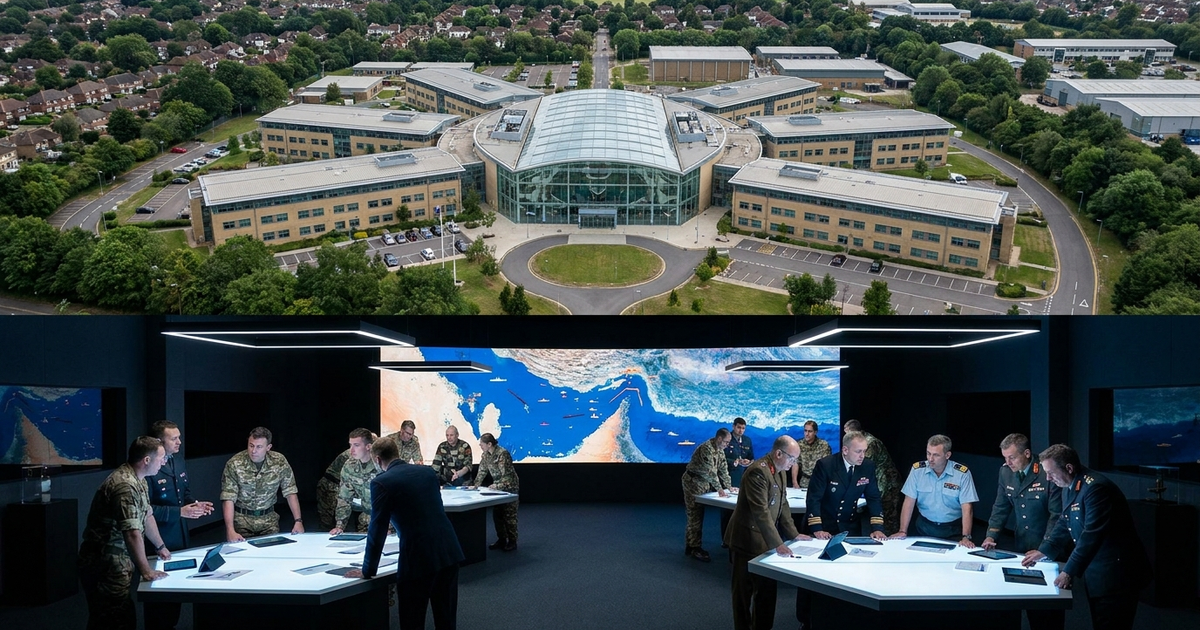
While the ceasefire is collapsing in the Gulf, something significant is quietly taking shape in a northwest London suburb.
On April 22 and 23, military planners from more than 30 nations gathered at the UK's Permanent Joint Headquarters in Northwood — the same command facility that coordinated Britain's operations in the Falklands, the Gulf War, and Afghanistan. Their task, as UK Defence Secretary John Healey put it: "to translate the diplomatic consensus into a joint plan to safeguard freedom of navigation in the Strait."
It is the most concrete multilateral military planning effort the crisis has produced. And it is happening almost entirely out of the headlines.
How We Got Here
The Northwood conference did not emerge from nowhere. It is the product of several weeks of accelerating European and allied diplomatic activity, running in parallel — and at times in deliberate contrast — to the U.S.-Iran bilateral track.
The momentum began to build in early April, when UK Foreign Secretary Yvette Cooper gathered foreign ministers from 40 countries in a virtual meeting to discuss options to reopen the strait. Then, on April 16–17, a Paris summit chaired jointly by British Prime Minister Keir Starmer and French President Emmanuel Macron brought together representatives of 51 nations. At that meeting — attended in person by German Chancellor Friedrich Merz and Italian Prime Minister Giorgia Meloni — the UK and France announced they would co-lead a defensive multinational mission to reopen the waterway once peace conditions allowed. The Paris summit also formally called for the "unconditional, unrestricted, and immediate re-opening of the Strait of Hormuz."
Notably, the United States did not attend the Paris talks.
That absence is significant. Washington has consistently signalled that it does not want allies' help in the active phase of the conflict — Trump said publicly that the U.S. did not need assistance. But the coalition building in Paris and Northwood is not about the war phase; it is about what comes after. And on that question, the Europeans appear to have decided not to wait for an American invitation.
It is worth noting how quickly the diplomatic ground has shifted. Trump had actually sought allied warships for Hormuz operations in mid-March, naming China, France, Japan, South Korea, and the United Kingdom. All declined. The reversal from universal refusal to a 30-nation planning conference took just 37 days.
What Northwood Was Actually Doing
The two-day conference at Northwood's Permanent Joint Headquarters focused on three distinct areas: military capabilities, command and control, and force deployment logistics.
One structural detail that received little attention but matters enormously: the conference deliberately used the UK's national command structure rather than NATO's Allied Maritime Command — despite both being housed at the same Northwood facility. This was not an accident. By operating outside NATO's framework, the coalition could include non-NATO Gulf and Asian partners without triggering alliance-level decision-making processes that would have complicated participation and slowed planning considerably.
The conference was not starting from scratch. A joint operational planning group had already been established and presented its initial findings on April 22, providing the factual foundation for the two days of detailed military discussion.
On capabilities, concrete commitments have begun to emerge. Italy's Navy chief of staff told state broadcaster RAI during the conference week that Italy is ready to deploy up to four vessels — two minesweepers, an escort vessel, and a logistics vessel. "Obviously we are not acting alone. We are part of an international coalition, and other nations will also send minesweepers," he said. Ukraine's potential contribution — four minehunters currently based in Portsmouth — was also discussed, a remarkable offer from a country still engaged in its own conflict.
What Came Out of It
When the two days concluded, Healey and his French counterpart Catherine Vautrin issued a joint statement that welcomed Trump's extension of the ceasefire and expressed cautious optimism: "We hope this ceasefire endures, solidifies, and leads to a definitive end to hostilities. Yet our work does not stop there."
The statement was signed alongside 36 other participating nations — 38 in total — expressing readiness to contribute to efforts to ensure safe passage and condemning attacks on commercial shipping.
On April 26, Starmer called Trump to report that more than 12 countries had formally volunteered to join the "peaceful and defensive" freedom-of-navigation mission. It was the first time a concrete multinational force structure had moved beyond communiqués and into joint military planning for Hormuz — a significant step, even if the mission itself remains contingent on a ceasefire holding.
The Coalition's Constraints — Including One That Rarely Gets Named
The Northwood coalition has a clear and openly stated limitation: it will not act while the war continues. Both the UK and France have been explicit that this is a post-ceasefire, strictly defensive mission focused on protecting commercial vessels and clearing mines once hostilities have ended.
But there is a second constraint that has received far less attention, and it matters enormously for how effective this coalition would actually be in practice.
France has attached two preconditions to deploying its naval forces: an Iranian non-fire pledge, and a U.S. commitment to allow open passage. Neither has been met. And France is not a minor contributor. Paris pledged 10 warships for a Hormuz mission in March, including assets from the Charles de Gaulle carrier strike group, which has been operating in the Mediterranean-Middle East region since early March. Without French naval weight, the coalition's ability to guarantee safe passage through an active mine threat is significantly reduced.
This is the gap between the diplomatic momentum that Northwood represents and the operational reality that would determine whether the mission succeeds.
Why This Coalition Matters Beyond the Strait
The Northwood conference is not just about the Strait of Hormuz. It is also a data point in a broader geopolitical shift: European nations and Indo-Pacific allies building genuine military capacity for collective action, independent of U.S. leadership.
What is striking is the speed of it. In mid-March, every ally Trump approached declined to get involved. By April 23, more than 30 nations had sent military planners to a working command facility and committed to a joint operational plan. The Paris summit had 51 nations and drew heads of government in person. The Northwood conference translated that political consensus into actual force packages, timelines, and logistics.
The UK and France — both permanent UN Security Council members with meaningful naval power-projection capability — are positioning themselves as the organisational backbone of a coalition that now spans Europe, Asia, and the Middle East. And crucially, they are doing it on purpose, with a non-NATO command structure designed to keep the coalition as broad and inclusive as possible.
The Unanswered Questions
Several critical questions remain open as the coalition's plans develop:
Will France's preconditions be met? An Iranian non-fire pledge and a U.S. open-passage commitment are not unreasonable demands — but neither is close to being agreed. Without them, France's 10-ship contribution is on hold, and the coalition's capability picture changes materially.
Will the U.S. participate in the post-ceasefire mission? Washington's absence from both Paris and Northwood does not necessarily mean it will stand aside from the reopening effort. Starmer's April 26 call to Trump suggests the lines of communication are open. But the nature of U.S. involvement — whether it leads, participates as an equal partner, or simply steps back — will shape how the mission is perceived by Iran and Gulf states.
How will Iran respond? Tehran has not commented specifically on Northwood, but its position on Hormuz access is well established: Iran has insisted on maintaining strategic leverage over the waterway as part of any deal, and has even proposed charging tolls for passage. A multinational mission designed to remove that leverage permanently will face Iranian opposition.
Does the mine threat complicate the mission's mandate? The coalition was conceived as a post-ceasefire, defensive operation. But Iran laid fresh mines this week — and the IRGC has vowed a strong response to any military ships transiting the strait. The "defensive only" mandate may face an early test if mine-clearing operations draw IRGC interdiction.
The Bottom Line
The Northwood conference is the most organised international response the Hormuz crisis has produced. Thirty-plus nations, real military planning, a deliberate command structure designed to maximise participation, and named capabilities on the table — including Italian minesweepers and, remarkably, Ukrainian minehunters sitting in Portsmouth.
It will not end the war. It cannot remove a single mine from the seafloor today. And France's unmet preconditions mean the coalition's full weight is not yet committed.
But it represents something that matters enormously for what comes next: a credible, prepared coalition that has moved from communiqués to operational plans, and that can deploy rapidly when the shooting stops. In a crisis defined by stalemate, that preparation is not nothing. It may, in the end, be the difference between a post-deal recovery that takes weeks and one that takes months.
See the numbers in real time
Track oil prices, ship transits, insurance premiums, and strait status — updated every hour.