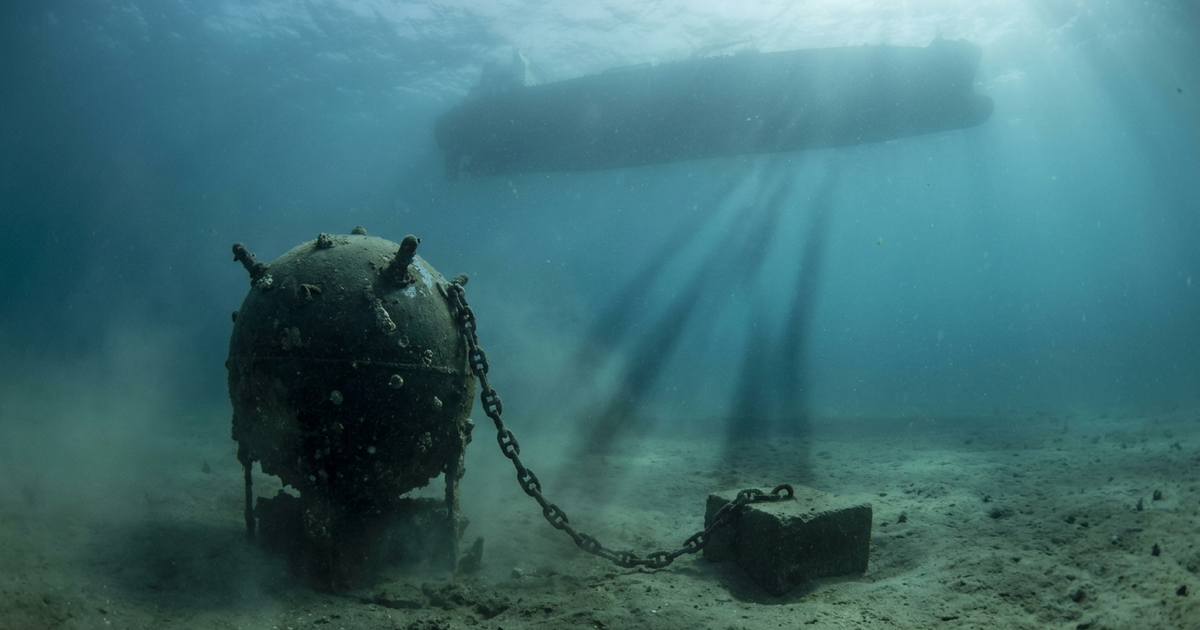
Diplomats can sign a ceasefire. Negotiators can agree on a text. But no piece of paper removes a mine from the seafloor.
As attention this week has focused on stalled peace talks, extended truces, and duelling blockades, a quieter and arguably more consequential story has been unfolding beneath the surface of the Strait of Hormuz: Iran has been laying more mines — and the United States, despite its overwhelming naval firepower, has no quick answer.
The mine threat is the part of this crisis that persists longest, costs least to sustain, and is hardest to resolve. It is also the part that most shipping professionals, energy traders, and policymakers are underestimating.
A Second Mining Campaign
The Strait of Hormuz was already a minefield — literally — before this week. Iran had deployed mines in the waterway earlier in the crisis, and U.S. mine-clearing operations began on April 11, when the destroyers USS Frank E. Petersen and USS Michael Murphy transited the strait to "set conditions" for de-mining, according to U.S. Central Command.
Then, this week, the IRGC went back to work.
According to a U.S. official and a separate source with direct knowledge of the situation, Iran's IRGC navy laid a fresh round of mines in the strait this week — the second deliberate mining campaign since the crisis began. U.S. forces detected the operation and have been tracking it closely. The exact number of new mines deployed has not been disclosed, though U.S. officials confirmed they know the figure.
President Trump's response came on Thursday via Truth Social: the U.S. Navy had been ordered to "shoot and kill" any Iranian boats caught laying mines, "with no hesitation." It is an escalatory instruction — and one that underscores just how seriously Washington is now taking the mine threat.
What Makes This Different From a Blockade
The blockades on either side of this conflict — the IRGC's control of the northern approaches and the U.S. Navy's enforcement of a port blockade — are political instruments. They can be switched off. A ceasefire, a deal, a sufficient concession from one side: any of these could end a blockade within hours.
Mines are different. They are physical objects on the seafloor, some of them potentially GPS-guided and difficult to locate. They do not know when the war has ended.
Iran's stockpile of naval mines is estimated by maritime analysts at between 2,000 and 6,000 units, a significant portion of which are domestically produced. Even before this week's fresh deployment, experts estimated that fewer than 100 mines had been laid — a relatively modest number, yet sufficient to create what one naval expert called a strategic effect that costs nothing to maintain. "The mined area does not have to be everywhere to be everywhere in the minds of those who must transit it," retired Romanian naval officer Alexandru Cristian Hudisteanu told Al Jazeera.
That psychological dimension is the point. Even the perception of a mined waterway is enough to invalidate war risk insurance, ground shipping operators' decisions, and suppress commercial traffic to near zero — without Iran expending a single additional weapon. It is, as former CENTCOM commander General Joseph Votel put it, a tool used to "buy time."
The U.S. Mine-Clearing Problem
The United States has a mine-clearing capability gap, and it is not a new problem.
The institutional roots go back to 2006, when the U.S. Navy dismantled Mine Warfare Command — the central organisation responsible for sustaining mine countermeasures doctrine, training, and procurement. That decision removed the internal champion for a mission the Navy has historically treated as a lower priority — until mines are actually in the water.
The current mine-clearing effort relies on two wooden-hulled vessels, the USS Chief and the USS Pioneer, which arrived in the region this week. Both were built in the early 1990s. The effort also involves underwater drones and potentially mine-hunting helicopters and surveillance aircraft — but experts caution that operating these systems in the strait is exceptionally dangerous given the ongoing threat of Iranian attacks.
The operational mathematics are unforgiving. A mine can be manufactured for as little as $1,000. In 1988, a single Iranian M-08 contact mine struck the USS Samuel B. Roberts, tore a 15-foot hole in the hull, broke the keel, and caused damage that took 18 months and $90 million to repair — equivalent to around $250 million in today's money. That asymmetry — cheap to deploy, extraordinarily costly to neutralise — defines the challenge now.
The Pentagon has yet to finalise a comprehensive mine-clearing operational plan, according to reporting from The Washington Post. Discussions are ranging from helicopter-based systems to explosive ordnance disposal divers. The Defence Intelligence Agency has assessed that Iran could keep the strait effectively closed for anywhere from one to six months using mines and other asymmetric tactics. Earlier this week, multiple U.S. officials confirmed that the six-month end of that range is now the planning assumption.
The Ceasefire Trap
Here is the crucial point for anyone following the diplomatic track: even if the U.S. and Iran reach a deal tomorrow, the strait does not reopen tomorrow.
The IRGC released a map during the ceasefire period showing what it described as a "safe route" through the strait — but that map also served as an implicit acknowledgement that the rest of the waterway carried an unquantified mine risk. It is not clear whether all mines from the first round of Iranian deployment have been located and neutralised, let alone the new ones deployed this week.
Commercial shipping operators are not going to send vessels through a waterway until a credible mine-free certification exists. Insurers will not cover vessels until that certification is backed by sustained naval operations and independent verification. That process takes weeks at minimum — and months if the IRGC's mine-laying has been more systematic than the low numbers publicly acknowledged suggest.
In short, any deal that ends the active conflict will still be followed by a mine-clearing phase that defines the actual timeline for economic recovery. The faster and more effectively that phase proceeds, the faster global energy markets normalise. The more complicated it becomes — due to fresh mining, IRGC interference, or U.S. capability constraints — the longer the damage continues.
What to Watch
Several indicators will tell you how the mine threat is evolving in the coming days and weeks:
Mine-clearing vessel movements. The arrival of USS Chief and USS Pioneer is a meaningful step, but these are two ageing ships operating in a hostile environment. Watch for any indication that NATO allies — particularly the UK and France, who are leading the multinational planning effort �� are moving additional mine countermeasure assets toward the region.
Ukrainian minehunters. Reports from the Northwood conference this week suggest that Ukraine may be prepared to deploy four minehunters currently based in Portsmouth to the strait once hostilities end. This would be a significant capability addition and a remarkable geopolitical development worth watching closely.
Insurance market signals. War risk insurance premiums are currently running at roughly 16 times their pre-crisis level. Any movement downward — even a small reduction — would signal that underwriters are beginning to price in a credible mine-clearing timeline. That would be the earliest market indicator of genuine progress.
Trump's public posture. The president's Truth Social post claiming that Iran was cooperating with the U.S. to remove mines was disputed by his own Pentagon officials, who said no such joint operation was underway. That gap between political messaging and operational reality is worth tracking. If a deal framework emerges, the mine-clearing choreography will be one of the first tests of whether both sides can actually execute it.
The Bottom Line
Mines are the detail that diplomats would prefer not to think about — because they are unglamorous, technical, and deeply inconvenient for any clean ceasefire narrative. They are also the detail that will determine whether a deal actually reopens the waterway, or simply provides political cover while the physical obstacle remains.
The IRGC understands this arithmetic perfectly. That is why they went back to the water this week, even as ceasefire talks continued in Islamabad. A few small boats. A few thousand dollars per mine. And the world's most important energy chokepoint stays effectively closed, regardless of what the negotiators agree.
Follow real-time shipping traffic, insurance premiums, and military movements at the Hormuz Strait Monitor dashboard.
See the numbers in real time
Track oil prices, ship transits, insurance premiums, and strait status — updated every hour.