The Most Important Meeting for Hormuz Is Happening Today — And It's Not About Hormuz
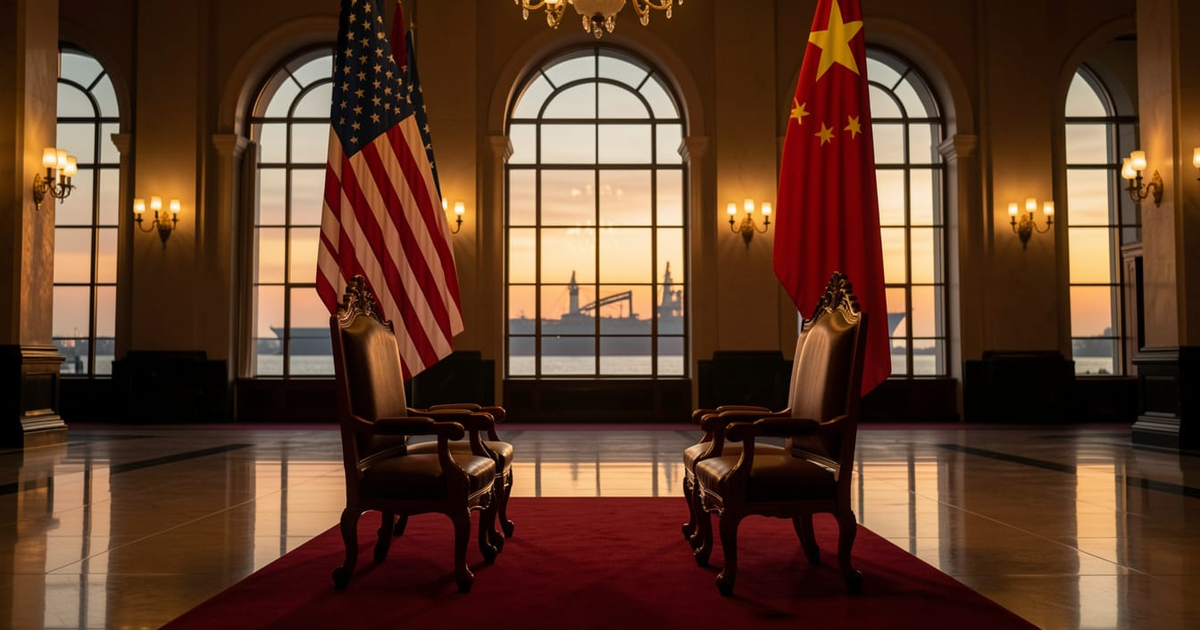
Donald Trump landed in Beijing this morning carrying more baggage than any American president has brought to a Chinese state visit in living memory. A war he can't end. A strait he can't reopen. Approval ratings at record lows. Gas at $4.52 a gallon. And a ceasefire he described, three days ago, as being on "massive life support."
Xi Jinping is waiting for him with something Trump has rarely encountered in this conflict: genuine leverage.
The question that will define the next phase of the Hormuz crisis is not what happens in the strait today, or what Iran's next move is, or whether the MOU framework can be revived. It is simpler and harder than any of those: what will China actually do? And what will Trump give Xi in return for doing it?
Why China Matters More Than Any Other Actor Right Now
The mathematics of China's position in this crisis are striking.
China sources close to 60% of its crude oil through the Strait of Hormuz. Around 84% of all crude moving through the strait is destined for Asia, with China as the world's largest crude importer and one of Iran's biggest oil buyers. Beijing has, on paper, an enormous economic interest in seeing the waterway reopen.
And yet China has, so far, done the minimum. Wang Yi has called for "prompt reopening" of the strait in diplomatic meetings. Beijing has repeatedly issued statements calling for an immediate ceasefire. China is credited with quietly nudging Iran back to ceasefire talks when negotiations wobbled in April — a contribution Trump has acknowledged, if inconsistently.
But Beijing has also told its domestic oil refineries to ignore U.S. sanctions levied against them for processing Iranian crude. It invoked a "blocking rule" for the first time, directing Chinese companies not to comply with Washington's sanctions — an unprecedented act of defiance. And it has built up large strategic oil and gas reserves specifically designed to insulate China from the kind of energy shock that is devastating the rest of the world. China is suffering from the Hormuz closure, but less than almost anyone else.
That combination — enormous stated interest in reopening, demonstrated reluctance to use leverage, and partial insulation from the worst consequences — defines the challenge Trump faces in Beijing today.
What Xi Could Do — In Theory
China's leverage over Iran is real. It is not unlimited, but it is the most significant single source of outside pressure on Tehran available to anyone in the current crisis.
The clearest form that leverage takes is economic. China is Iran's largest trading partner and the primary buyer of its oil. Iranian petroleum exports to China have continued throughout the war, flowing through channels that U.S. sanctions have not fully closed. If Beijing were to meaningfully reduce those purchases — or even credibly threaten to do so — the economic pressure on Tehran would intensify significantly. Iran's ability to sustain the war, and to hold out on nuclear concessions, depends in part on Chinese demand for its oil.
China also has diplomatic leverage that no other actor possesses. Araghchi was in Beijing just last week. Wang Yi has spoken with his Iranian counterpart at least three times since the war began. Beijing has a communication channel with Tehran that Washington does not — and Iran, for all its public defiance, has historically been sensitive to Chinese signals. It was Chinese pressure, according to multiple sources, that helped bring Iran back to the table in April when the first ceasefire was collapsing.
There is also what might be called leverage by association. Iran attacked a Chinese-owned oil tanker in the strait last week. Kuwait has accused Iran of sending IRGC paramilitaries to attack an island housing a China-funded port project. These are not acts designed to maintain a strategic partnership. They suggest Iran feels confident enough in Chinese backing — or indifferent enough to Chinese concerns — to damage Chinese interests directly. Xi has every reason to communicate to Tehran that this behaviour has consequences.
What Xi Will Actually Do — In Practice
The gap between what China could do and what it will do is the central question of the Beijing summit, and the White House has already set expectations accordingly. Ahead of Trump's departure, U.S. officials signalled openly that they did not expect Xi to change China's posture on Iran.
That caution is well-founded. China's strategic calculus is more complicated than its economic interest in reopening the strait.
First, Beijing does not want to be seen as Washington's enforcement mechanism. Using its leverage over Iran at American request would position China as a tool of U.S. foreign policy — damaging its standing with Tehran, with Russia, and with the broader group of non-Western nations China is actively courting. "They are very cautious, risk averse, and they don't want to be involved in anything that would drag them into something they don't consider their problem," as one Chatham House analyst put it.
Second, the war has given Xi leverage over Trump that he would not otherwise have. The U.S. needs rare earth minerals from China to rebuild its stockpile of missile interceptors depleted by the conflict. It needs Beijing's cooperation on trade stabilisation, semiconductor supply chains, and the broader economic relationship. Every week the war continues and gas prices stay above $4.50, Trump's domestic political position weakens — and his need for a diplomatic win in Beijing grows. From Xi's perspective, the longer the stalemate continues, the more concessions Trump may offer for Chinese help.
Third, China is already getting something it wants without doing anything. As the Chatham House analysis of the summit notes, Trump's war has "handed China's leadership advantages of which it cannot have dreamed before he arrived in the Oval Office." Allies driven toward Beijing by U.S. tariffs. NATO questioned. U.S. military attention consumed. The war is, from a Chinese strategic perspective, not entirely unwelcome.
The Transaction Xi Needs
If China is going to meaningfully increase pressure on Iran, it will not do so out of goodwill. It will do so as part of a transaction — and the contours of what Beijing wants are reasonably clear.
China wants formal U.S. recognition of the trade truce reached in South Korea last year. It wants relief from the latest rounds of sanctions on Chinese refiners buying Iranian crude — sanctions that Beijing views as a direct attack on its economic sovereignty. It wants progress on rare earth export controls, which Beijing suspended in a countermeasure that is now squeezing U.S. defence production. And it wants, at minimum, a credible signal from Washington on Taiwan that does not involve further arms sales in the near term.
None of these are small concessions. And Trump arrives in Beijing with a delegation that includes Apple's Tim Cook and Tesla's Elon Musk — a signal that economic wins are the summit's primary objective, with Iran as a secondary agenda item that both sides appear content to treat as important but not central.
The risk, flagged explicitly by Chatham House and others, is that Trump trades long-term strategic concessions — on Taiwan, on technology competition, on the rules-based order — for short-term deliverables: soybean purchases, Boeing orders, and vague language on Hormuz de-escalation that produces no actual change on the water.
The 84% Problem
There is one number that should concentrate minds in Beijing more than any other: 84.
Eighty-four percent of all crude moving through the Strait of Hormuz is destined for Asia. China, Japan, South Korea, India, Singapore — the entire engine of Asian economic growth depends on a waterway that Iran controls and the U.S. cannot force open. That is not a Western problem wearing an Asian face. It is an Asian problem that only Asian economic weight — particularly Chinese economic weight — can help resolve.
The Chatham House analysis makes this point sharply: Asian countries including China have been among the most affected by the interruption to supplies of oil, gas, fertiliser, and helium (critical for semiconductors and healthcare). China's strategic reserve buffers are real, but they are not infinite. The longer the strait stays closed, the more those buffers erode and the more the economic pressure shifts toward Beijing.
That trajectory ultimately works in Trump's favour — if he can wait long enough. But with approval ratings falling and the midterms approaching, patience is not his strongest suit.
Three Scenarios for What Comes Out of Beijing
Scenario 1 — Thin deliverables, vague language The most likely outcome, according to analysts, is a joint statement that calls for Hormuz reopening "as soon as possible," commits both sides to continued dialogue, and produces no specific Chinese commitment to pressure Iran. Markets might briefly rally on the communiqué language before realising nothing has changed on the water. This outcome extends the stalemate.
Scenario 2 — A private deal with public silence Xi agrees privately to signal displeasure to Tehran — reducing oil purchases marginally, delivering a sharper diplomatic message through the Wang Yi channel — without making any public commitment. Iran gets the message. The strait begins to open within weeks. Neither Trump nor Xi says why. Both claim credit for different reasons. This is the outcome that would most directly compress the recovery timeline — and the one least likely to be reported accurately when it happens.
Scenario 3 — A genuine strategic transaction Trump offers Xi something significant — movement on Taiwan arms sales, tariff relief, technology concessions — and Xi in return delivers meaningful pressure on Tehran. This scenario is the most transformative and the most dangerous, because the concessions required to make it happen could reshape the Indo-Pacific security order in ways that outlast the Hormuz crisis by decades.
The White House's low expectations suggest Scenario 1 is the planning assumption. But summits have a way of producing surprises — in both directions.
The Bottom Line
Xi Jinping has more leverage over this crisis than any other actor, including the United States. He has leverage over Iran through trade and diplomacy. He has leverage over Trump through rare earths, the trade relationship, and the simple fact that America needs China's help to end a war it cannot finish alone.
What Xi will do with that leverage — and what he will charge for it — is the most important unknown in the Hormuz crisis today. The summit begins in hours. The world is watching Beijing, not the strait.
Track vessel movements, energy prices, and diplomatic developments in real time at the Hormuz Strait Monitor dashboard.
See the numbers in real time
Track oil prices, ship transits, insurance premiums, and strait status — updated every hour.